Rapid Prototyping of Applications for µP-Based ECUs
Flexibility and Time Savings
Rapid prototyping means turning ideas into running systems within minutes - without losing sight of what comes next. The Vector Application Framework provides a straightforward setup via GitHub, VS Code integration and a ready-to-use Docker image, making it easy to get started.
Its fully text-based, middleware-independent approach keeps workflows consistent and accessible, while built-in abstractions allow prototypes to evolve towards production-ready architectures. This way, early results remain usable - beyond the first prototype.
The Challenge
Rapid prototyping of an embedded and distributed system can be described as transformation of a project idea into an executable program and running prototype in minutes. To make this possible, an environment for this purpose needs to fulfill certain requirements. This includes most and foremost good accessibility, low entry barriers, and ease of use.
Only frameworks with such characteristics bring ideas to life and help to speed up projects in a Hackathon setup or when creating a test node, for example.
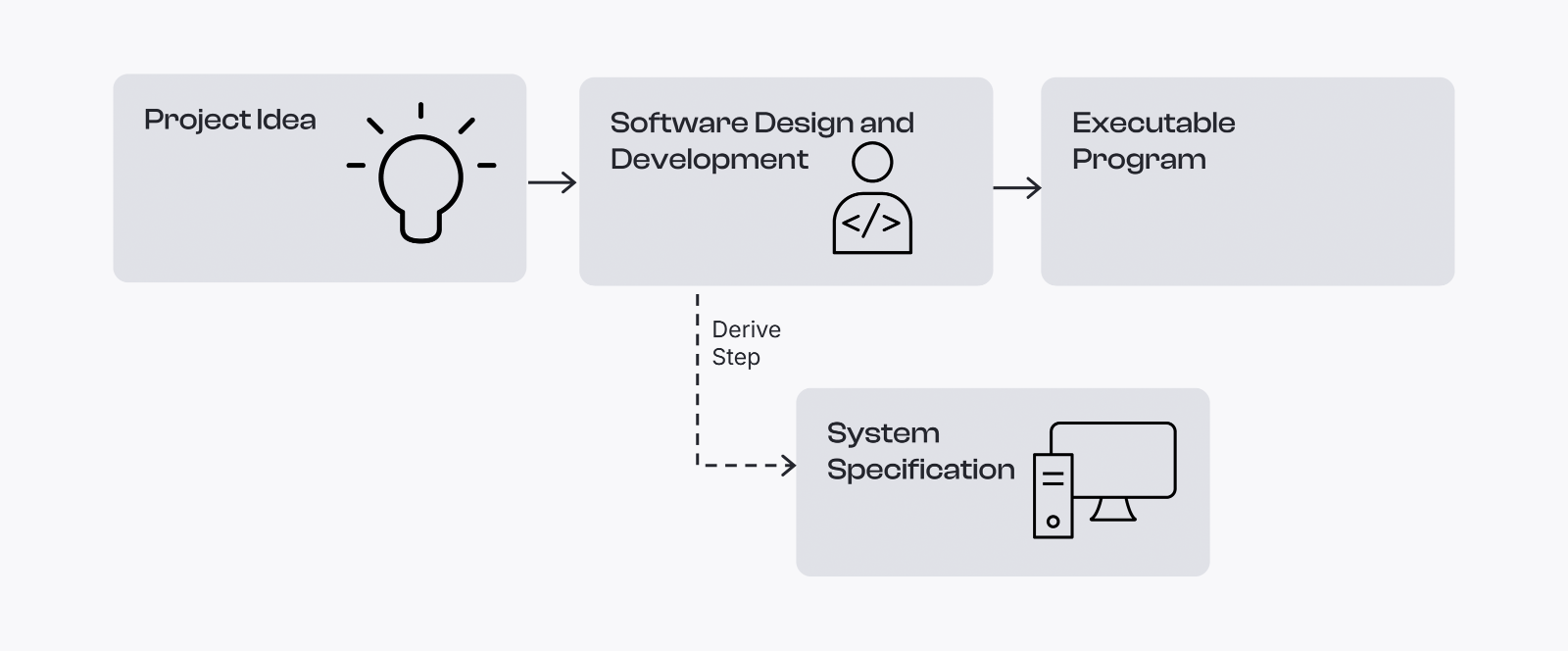
Unfortunately, this initial and fast creation of an executable program is only part of the equation. If a prototype is found to be good, a migration scheme to a suitable development workflow for production systems is needed. Specification-driven development is one way for the creation of production-grade software and common practice in the automotive industry.
According to this pattern, modeling of the software system goes first. This way of working contrasts with prototyping, however, where the implementation part is in first place. Yet, to enable migration, existing design and implementation artifacts from the prototyping phase must support derivation to a specification. Otherwise, prototype development becomes a dead end.
The Solution
Starting a new prototyping project is supposed to be as easy as possible. That is why the Vector Application Framework is available for evaluation and prototyping purposes free of charge. This Community Edition is provided with specific special terms of use and publicly available in the Vector Group (vectorgrp) GitHub organization.
The whole solution, including all dependencies, is bundled as Docker image and therefore ready-to-use. A dedicated extension further ensures direct integration with the commonly used development environment Microsoft Visual Studio Code (VS Code).
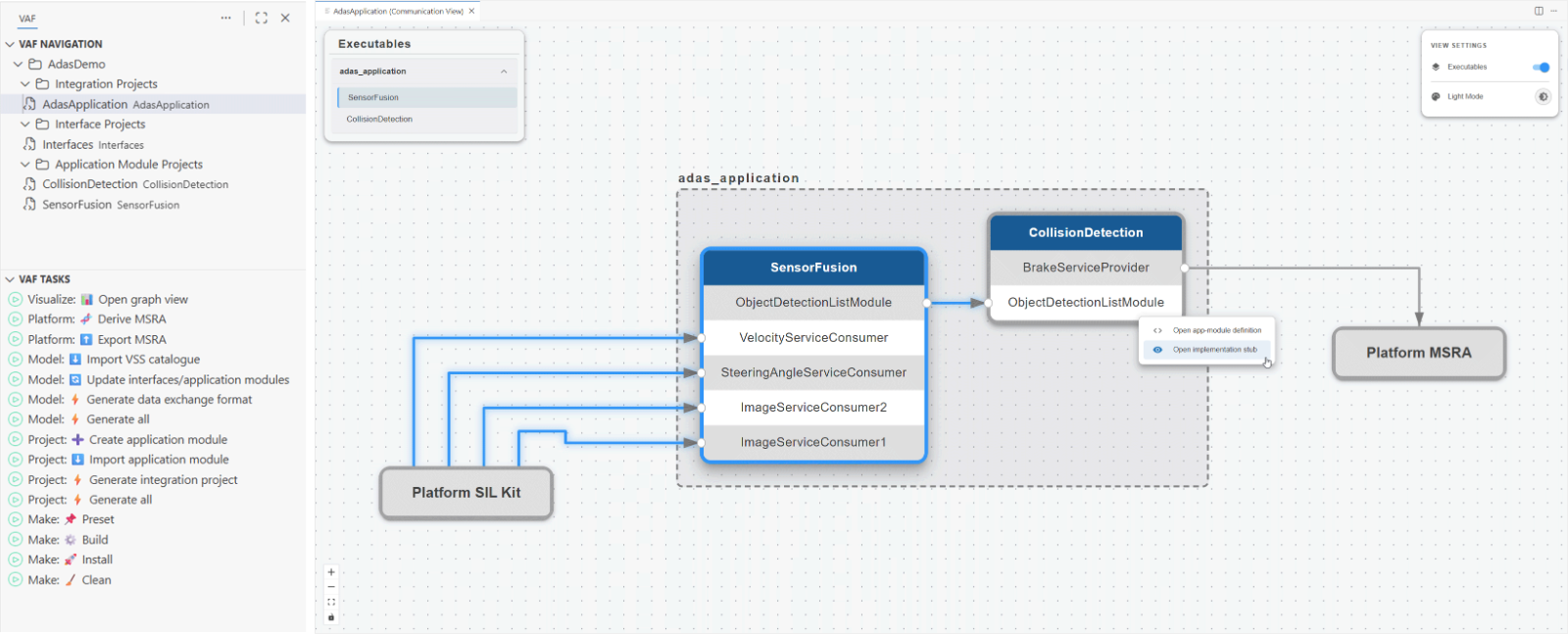
The two main features of this extension are straightforward project navigation and task execution, on the one hand, as well as graphical illustration of executables and modules in form of an interactive software architecture graph, on the other hand.
Moreover, complete tooling and all work artifacts of the framework are text-based. Meaning to say, there is no need to switch between tools or windows any more as the complete workflow can be accomplished in VS Code. Cloud-hosted development environments such as GitHub Codespaces allow usage of the framework even in a web browser.
To further ease the work with the framework, middleware details are hidden and domain-specific terminology from the field of automotive software is avoided. This is done in favor of general terms and patterns that are established in computer science to make it understandable for all target groups and not only for experts. In essence, there are two basic communication principles, data elements and operations. The former map to pub/sub messaging alongside with event-driven communication and can further be used for the persistent storage of data in a key-value database. The latter matches the pattern of remote procedure calls. Interfaces allow to group either combination of them.
The central promise of independent application development is realized by so-called abstraction modules. This is where the mapping of application-facing interface to a concrete middleware solution and API happens. Implementations of those modules in different quality levels exist, amongst others, for Vector SIL Kit, DDS, MICROSAR Adaptive, or the Eclipse S-CORE communication module. This clear separation of application code from the middleware solution provides the flexibility needed for projects that start with prototyping and later migrate to a production setup. During early evaluation, Vector SIL Kit can be used for integration and execution tests for example. This library for the connection of Software-in-the-Loop (SIL) environments is available open source and requires little configuration effort. Needed artifacts for the integration are completely provided by the framework. In other words, it just works. The following production system could migrate to the field-proven MICROSAR Adaptive middleware then. If needed, AUTOSAR model artifacts (ARXML) can be generated by the framework as a starting specification to be modified and tailored iteratively. Merging with existing specification artifacts can also be accomplished within the framework. ARXML, various IDL formats, or the Vehicle Signal Specification (VSS) are supported to be read as input files.
Altogether, the Vector Application Framework is a perfect fit for the full range from prototyping to production of distributed applications and microprocessor-based systems. Give it a try and start your own project. You’ll be surprised how fast an idea can be converted into a running executable program.
The Advantages
- Open and transparent. API and core components of the framework are open source available in an Eclipse.SDV project.
- Easy accessibility. A free of charge evaluation bundle of the Vector Application Framework is available on GitHub.
- Ease of use. Integration with VS Code and provision as ready-to-use Docker image allow usage w/o prerequisites.
- Low entry barriers. Domain-specific terminology is avoided. Instead, the framework is based on established terms and patterns from the field of computer science.
- Fully text-based. All artifacts for design, implementation, and test are filed in a textual representation. All workflow steps can be done in one IDE. Further, this characteristic is a perfect fit for Git-based collaboration and AI agents.
- Middleware independence. Application development is possible without knowledge of the underlying middleware, supporting separation of concerns and by that true portability and reuse.
- Migration to production. Middleware model artifacts get generated by the framework and enable migration to a specification-first working mode and production setup.