
MICROSAR Hypervisor
MICROSAR Hypervisor is a standalone Type‑1 hypervisor for MCU platforms that offer hardware core-virtualization support. It provides strict spatial and temporal isolation between virtual machines, allowing multiple virtualized independent and isolated OS or bare-metal instances (Virtual Machines/VMs) to run safely and efficiently on a single microcontroller on one or more cores.
The solution addresses system architects and technical decision‑makers who need to consolidate software, reuse existing ECU projects, or partition systems with different safety or security requirements, while keeping development workflows independent.
Key Benefits at a Glance
- System consolidation without risk
Run multiple isolated systems on one controller while maintaining secure separation. - Minimal performance overhead
Designed for embedded use cases with less than 1% overhead in standard setups.* - Independent development paths
Develop, integrate, and update virtual machines separately - without cross‑dependencies.
- Seamless integration with proven functional safety
The solution integrates seamlessly into the MICROSAR ecosystem and is developed according to ISO 26262 up to ASIL-D. - Efficient reuse of existing software
Reuse and combine independent ECU projects instead of redesigning them. Fast setup and configuration
Typical configurations can be set up within a short time frame.**Details to be validated / reviewed internally.
Key Features of MICROSAR Hypervisor
MICROSAR Hypervisor focuses on what matters most in embedded systems: isolation, determinism and control.
Virtualization & Isolation
Hardware‑assisted Type‑1 Hypervisor
Runs directly on the microcontroller for predictable, low‑latency behavior.Secure separation
Memory, peripherals, and registers are strictly isolated between virtual machines.
Interface & Compatibility
Management interface
Hypervisor itself and other VMscan be managed at runtime (system startup and shutdown, start, stop and restart of VMs).Compatibility
Any operating system that supports running in virtualized mode on the target platform.
Scheduling & Resource Protection
Time‑slice scheduling
Deterministic switching between virtual machines.Runtime system protection
Prevents faulty or unintended interactions across partitions.
Integration & Lifecycle
MICROSAR Classic integration
Fully aligned with the Vector’s MICROSAR ecosystem.Independent VM integration
Virtual machines can be integrated and validated independently.
Deterministic Execution with Strict Isolation
MICROSAR Hypervisor is a standalone Type 1 hypervisor for MCU platforms that offer hardware core-virtualization support. It enables to run multiple virtualized independent and isolated OS or bare-metal instances (Virtual Machines/VMs) on one or more cores.
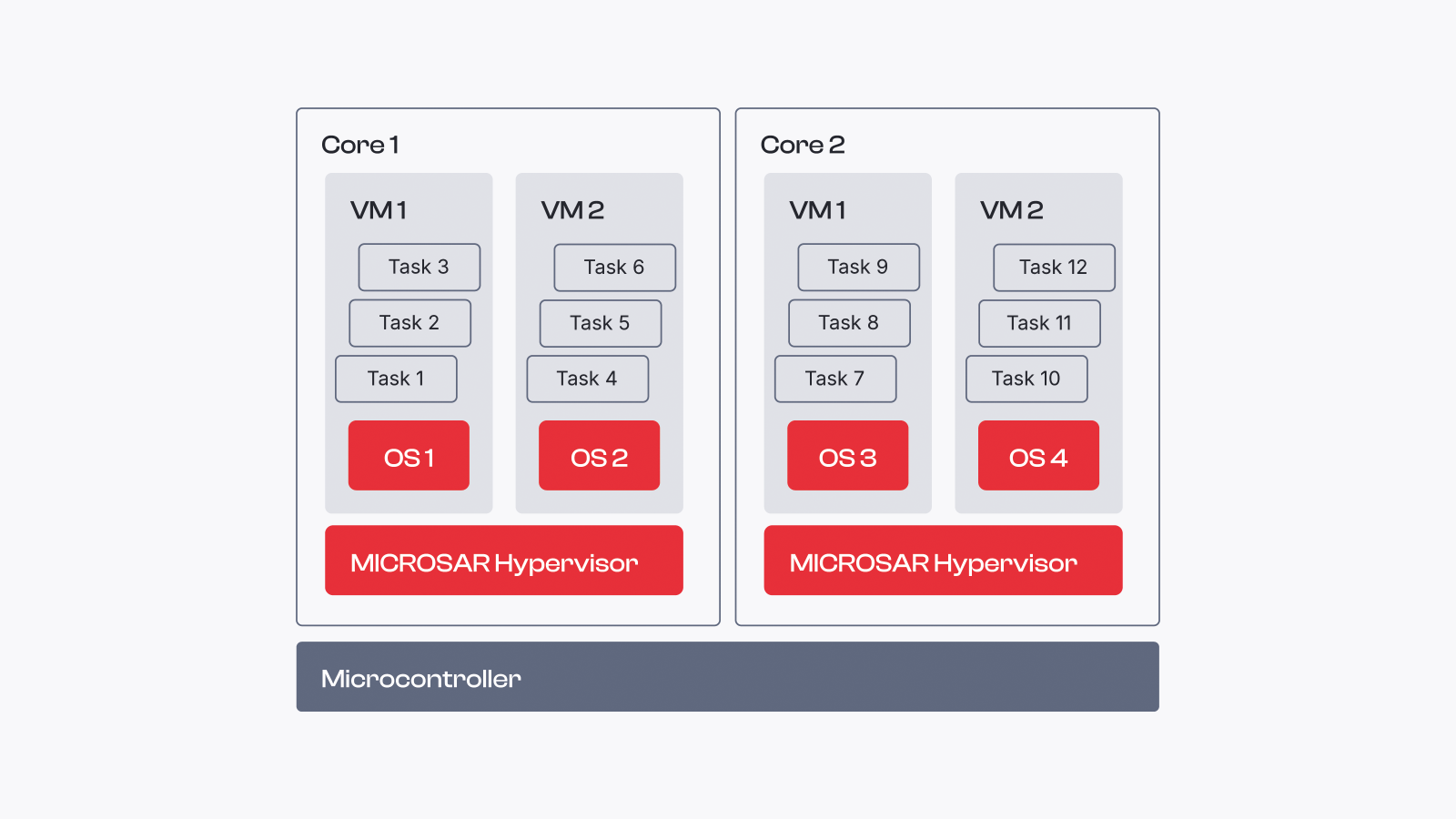
At startup, the hypervisor initializes hardware resources and assigns them to defined virtual machines.
Each VM operates in its own protected context with controlled access to shared resources.
Scheduling and interrupt handling remain deterministic and transparent to the application layer.
This approach enables safety‑oriented partitioning without introducing unnecessary complexity into application software.
Resources can be allocated to the individual VMs in a dedicated way, while access to these resources from other VMs is prevented by the Peripheral Protection Management. MICROSAR Hypervisor can also manage interrupts and make them available to the individual VMs in their time slice. The Hypervisor is compatible with any operating system. Thus, existing projects can be run together without any changes. A consolidation of several projects on one microcontroller can be easily realized.
The Hypervisor additionally provides an interface (API) that can be used both for secure communication between individual VMs as well as for managing the Hypervisor in operation. This enables resource sharing and system management - for example, by restarting individual VMs through a central instance.

Enable Flexible Architectures and Scalable Integration
Typical scenarios where embedded virtualization simplifies system design and operation.
- System consolidation
Combine multiple standalone systems on one controller to reduce hardware complexity. - Mixed‑criticality architectures
Separate software with different safety or cybersecurity levels at runtime.
- Reuse of legacy projects
Integrate existing ECU software into new architectures without refactoring. - Parallel development
Allow teams to develop and test software independently within isolated virtual machines.
More Insights
Software Platform Services
Software Platform
Training & Certification