
An Ethernet switch enables efficient communication between vehicle components in Software-Defined Vehicles (SDVs), this is MICROSAR Switch. It provides advanced switching capabilities for high-speed, secure, and reliable data exchange, supporting the complex and data-intensive requirements of modern automotive systems.
MICROSAR Switch is designed for software engineers, system architects, and technical leads who develop and integrate Ethernet-based networks. It supports projects that range from legacy network designs to scalable, zonal and software-defined architectures.
Key Benefits at a Glance
- Adapt to Diverse Network Architectures
Deploy MICROSAR Switch across a wide range of Ethernet communication scenarios. From legacy network designs to advanced zonal architectures with multiple ECUs and high-performance computing platforms - Reduce Load on Host Controllers
Offload key networking tasks such as initialization, traffic inspection, time-sensitive networking, and health monitoring to the switch firmware to improve startup time and runtime performance - Enable Scalable and Secure SDV Networking
Manage dynamic switch configurations, simplify updates, and ensure comprehensive network security to support evolving Software-Defined Vehicle architectures
- Integrate Seamlessly into Existing Networks
Import existing network descriptions such as AUTOSAR communication extracts and incorporate switch updates into established processes - Ensure Vendor-Independent Development
Use a hardware-agnostic solution based on proven MICROSAR Classic software and tooling to create a consistent, efficient development workflow across switch platforms
Key Features of MICROSAR Switch
MICROSAR Switch combines switch control, cybersecurity, and lifecycle integration in a single software stack.
Advanced Networking & Diagnostics
Optimized, deterministic ethernet communication
Time-sensitive networking (TSN) –related functions and precise time synchronization support (depending on hardware capabilities)
Robust diagnostics for monitoring network health
Switch Management & Configuration
Configure Ethernet switch parameters using standardized workflows
Maintain consistent behavior across different switch vendors and devices
AUTOSAR-based configuration via imported extracts possible
Security
Hardware-accelerated firewall filtering
Deep packet inspection support
Integration of intrusion detection reporting mechanisms
MACsec support
Software Updates
Software updates with verification, downgrade protection, and key revocation
Updatable firewall policies for evolving vehicle network security
Transparent flash access without OTA option or on‑switch bootloader
MICROSAR Switch in Everyday Development
MICROSAR Switch is a scalable, feature-rich and highly customizable firmware, specifically engineered for Ethernet switches with an integrated CPU subsystem. It abstracts vendor-specific details and exposes a consistent configuration and management interface.
Typical Steps to Get Started
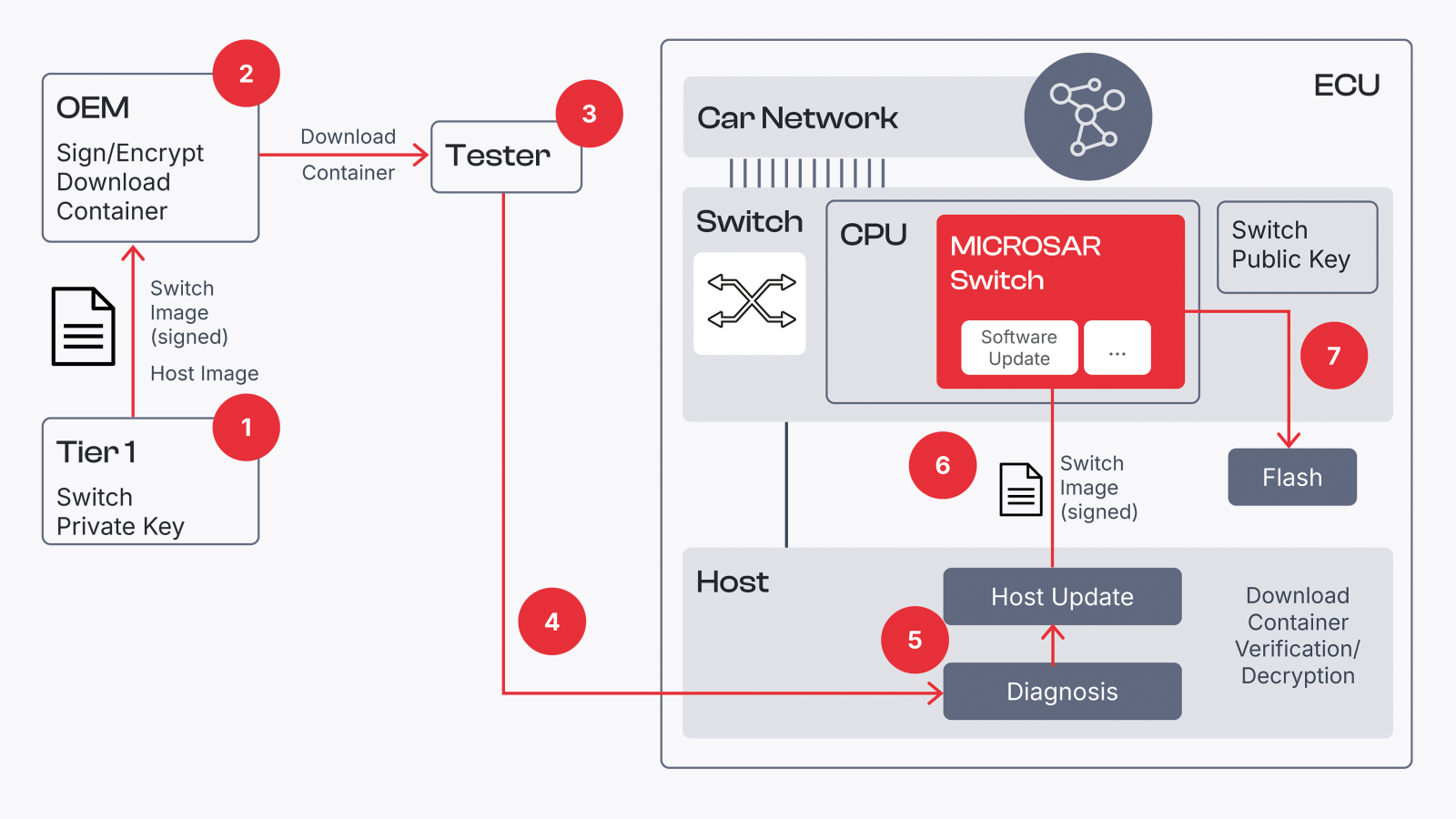
1. The Tier 1 creates a signed switch image and optionally also a host image.
2. The OEM creates a download container from these images. The container gets optionally signed and or encrypted it based on the OEMs requirements.
3. The download container is rolled out, so that it can be downloaded by external testers.
4. The tester establishes a connection with the host controller or processor on the ECU that runs the diagnostic stack.
5. The host forwards the request to corresponding internal submodule that is responsible for the software update.
6. The host uses MICROSAR Switch’s communication interface vRpcProxy to transfer- and control the update via an ECU-internal Ethernet link.
7. Using the memory driver, the image is written to the external flash.

Inside MICROSAR Switch
A closer look at how MICROSAR Switch fits into your system architecture.
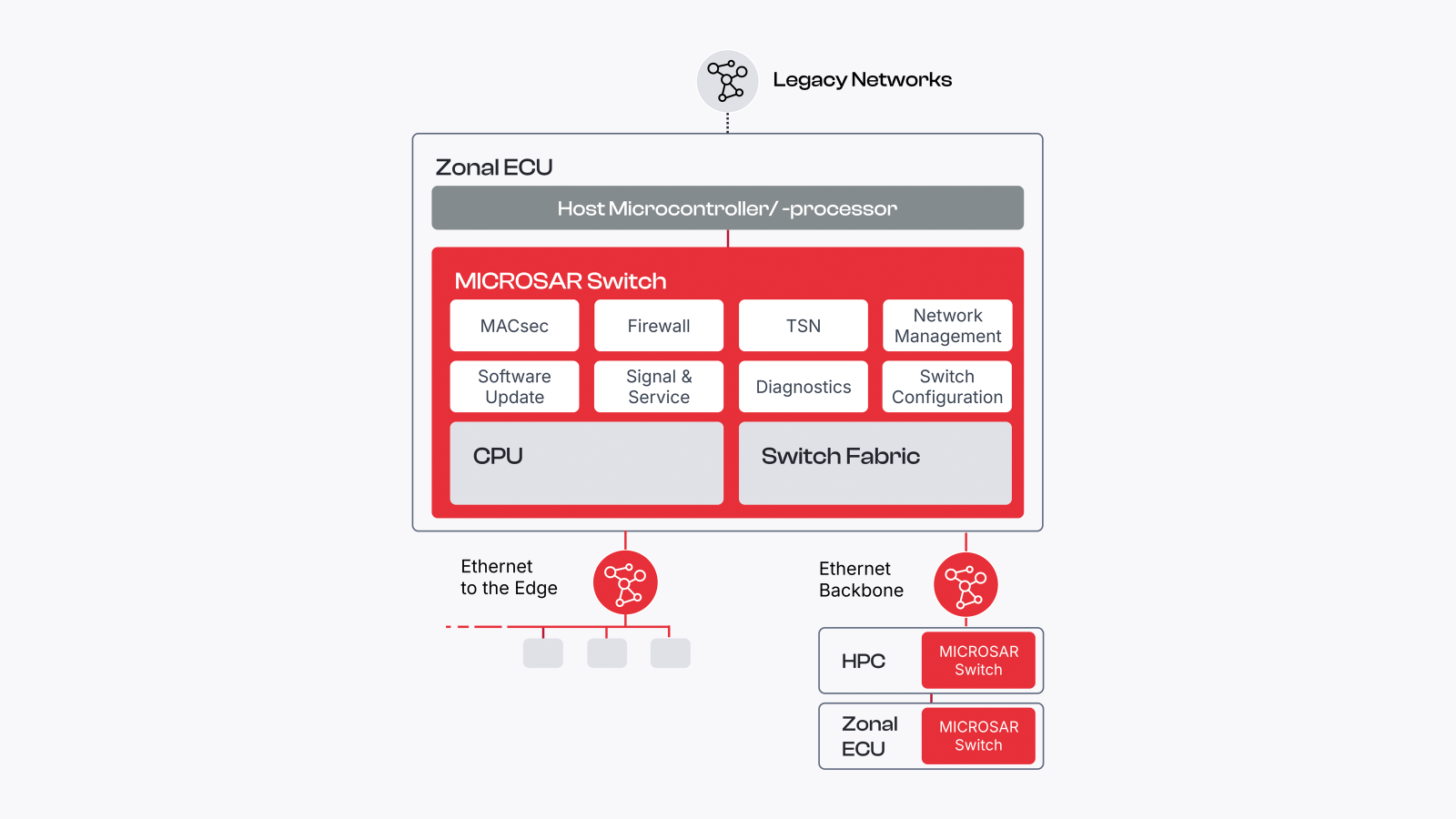
The depicted network topology illustrates the typical zonal architecture used in Software-Defined Vehicles. The zonal ECU is built around a Switch SoC with an integrated CPU subsystem, along with a host microcontroller and/or microprocessor.
Key architectural aspects
Defined interfaces for configuration, monitoring, and diagnostics
Designed for integration into larger software platforms and toolchains
Seamless Integration of switch software updates into the OEM process
Full compatibility with AUTOSAR, including a built-in protocol for host connectivity
More Insights
Software Platform
Software Platform Services
Software Defined Vehicle