Functional Safety and Industry Standards
Every functional safety standard is built around a risk classification system. The classification determines the severity of potential harm, assigns a corresponding integrity level to the software, and mandates verification activities proportionate to that level. The specific terminology differs across sectors, ASIL under ISO 26262, DAL under DO-178C, SIL under IEC 61508 and EN 50716, but the verification obligations are consistent: requirements-based testing, structural coverage measurement, tool qualification, and documented traceability.
ISO 26262: Automotive
ISO 26262 is the international standard for functional safety of electrical and electronic systems in road vehicles. The second edition, published in 2018, applies to cars, trucks, buses, vocational vehicles, and motorcycles.
Each development project begins with a Hazard Analysis and Risk Assessment (HARA), which determines the Automotive Safety Integrity Level (ASIL) for safety-relevant functions. ASIL ranges from A (lowest residual risk) to D (highest residual risk), with QM (quality management only) for non-safety-relevant software.
Verification requirements scale with ASIL. At ASIL D, statement, branch, and MC/DC coverage are all required, along with bidirectional requirements traceability and structured unit testing. At lower ASIL levels, the coverage criteria and method recommendations are progressively relaxed.
Vector tool support for ISO 26262
- PC-lint Plus is certified by exida for ISO 26262:2018 at ASIL A through D
- VectorCAST coverage measurement certified by TÜV for all ASIL levels, Industry Mode automatically selects correct coverage criteria per ASIL
- Squore aggregates ISO 26262 compliance data from across the toolchain including MISRA findings, test results, and coverage metrics
DO-178C: Aerospace
DO-178C, Software Considerations in Airborne Systems and Equipment Certification, is the primary standard for approving commercial software-based aerospace systems. Published jointly by RTCA and EUROCAE, it replaced DO-178B in 2012.
DO-178C assigns Development Assurance Levels (DAL) from A (catastrophic failure consequence) to D (minor consequence). The core of the development process is a requirements-based approach with full bidirectional traceability from High-Level Requirements and Low-Level Requirements through source code, executable object code, and test cases, procedures, and results.
Level A software requires MC/DC coverage for all decisions. This is among the most demanding structural coverage requirements of any standard and is a key driver of VectorCAST's MC/DC automation capabilities.
Vector tool support for DO-178C
- VectorCAST: Our Tool Qualification Package for DO-178B and DO-178C contains tool qualification documentation, test cases, and procedures that let you qualify VectorCAST tools on projects based on the DO-178B/ED-12B or DO-178C/ED-12C standard.
- Squore: requirements coverage monitoring and completeness tracking across the project
IEC 61508: Industrial
IEC 61508 is the foundational international standard for functional safety of programmable electronic systems. It governs industrial applications including factory control systems, process automation in chemical plants, and any other safety-related programmable system not covered by a sector-specific standard.
IEC 61508 is structured in seven parts. Part 3 covers software requirements and defines the software safety lifecycle including validation and verification. The standard defines Safety Integrity Levels from SIL 1 to SIL 4. At SIL 2 and above, the use of certified tools is strongly recommended. At SIL 3 and SIL 4, it becomes effectively mandatory for practical compliance.
IEC 61508 is also the basis from which ISO 26262, EN 50716, and several other sector-specific standards are derived.
Vector tool support for IEC 61508
- PC-lint Plus: certified by exida for IEC 61508:2010 at SIL 1 through SIL 4 (SIL 4 qualified)
- VectorCAST: TÜV-certified coverage measurement, Industry Mode selects correct criteria per SIL level
IEC 62304: Medical Devices
IEC 62304 governs the software lifecycle process for medical devices. It classifies software components into three safety classes: Class A (no injury or damage possible), Class B (non-serious injury possible), and Class C (serious injury or death possible).
Verification requirements scale with class. Class C software requires the most rigorous verification activities, including unit testing with structural coverage measurement and requirements traceability. Any software component that could affect patient safety must be identified, classified, and verified accordingly.
Vector tool support for IEC 62304
- PC-lint Plus: certified by exida for IEC 62304
- VectorCAST: supports requirements-based testing and structural coverage for Class B and Class C software components
EN 50716: Railway
EN 50716:2023 governs software for safety-critical electronic systems in railway applications, superseding EN 50128:2011 and EN 50657:2017. It is derived from IEC 61508 and adapted to the specific requirements of railway signaling, control, protection, and rolling stock applications. Software Integrity Levels run from SIL 0 through SIL 4. MC/DC coverage is required at SIL 4.
Vector tool support for EN 50716
- PC-lint Plus: exida certified
- VectorCAST: TÜV-certified coverage measurement covering EN 50716:2023, supports MC/DC for SIL 4 compliance
IEC 60880: Nuclear
IEC 60880:2006 covers software for computer-based instrumentation and control systems in nuclear power plants performing Category A safety functions. The standard covers requirements for all software lifecycle activities and is similar in scope to Part 3 of IEC 61508. Verification requirements include requirements-based testing, structural coverage measurement including MC/DC, and documented traceability throughout the software lifecycle.
Vector tool support for IEC 60880
- VectorCAST: TÜV-certified coverage measurement covering IEC 60880:2006, supports MC/DC coverage for Category A compliance
Tool Qualification: Why It Matters
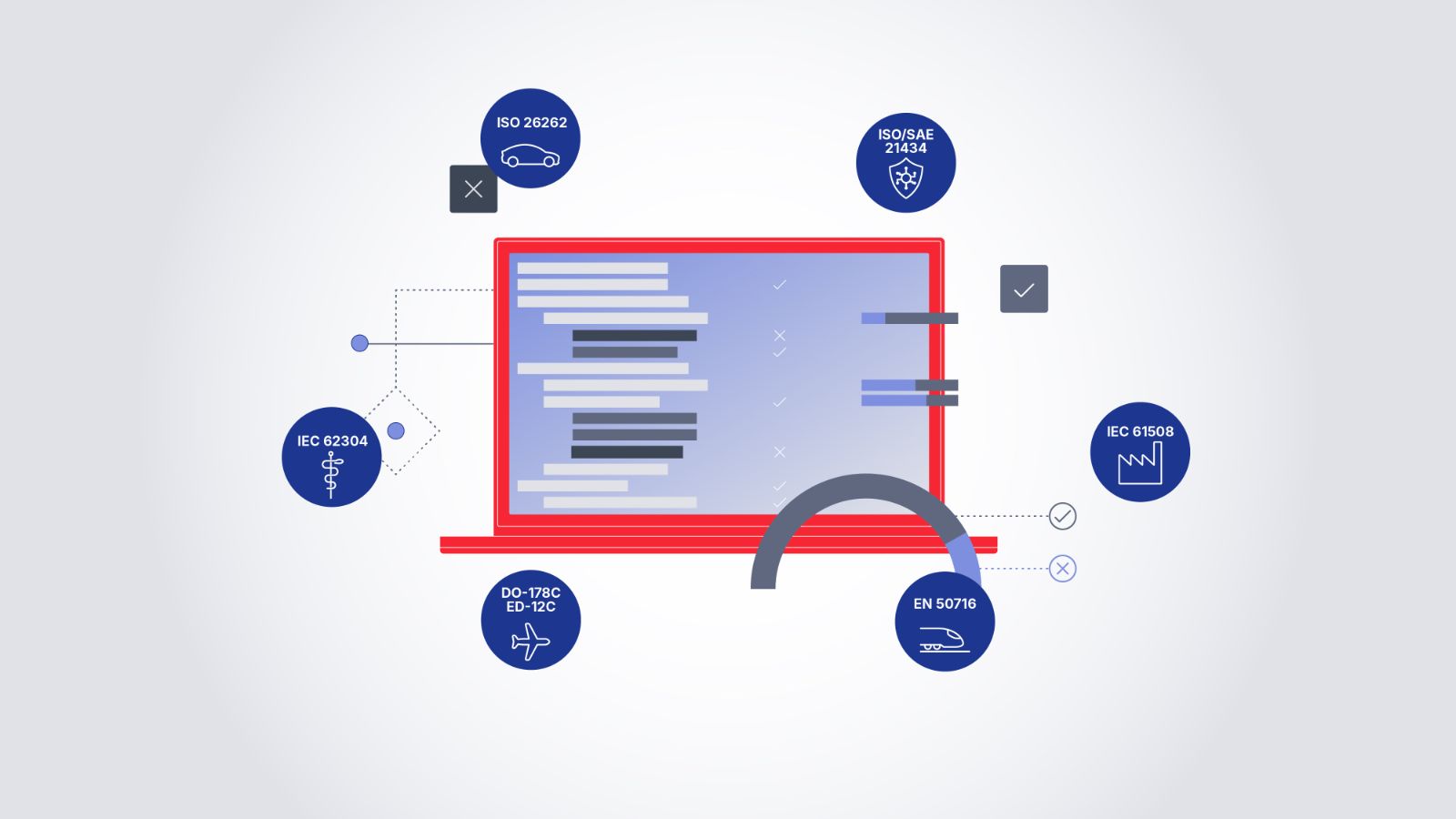
Standards including IEC 61508, ISO 26262, and DO-178C require that tools used in the verification process are themselves qualified or certified. A test result or static analysis finding is only acceptable as compliance evidence if the tool that produced it can demonstrate it operates correctly and consistently.
Qualifying a general-purpose tool for use under these standards is a significant effort. Tools certified specifically for compliance remove that burden entirely.
PC-lint Plus is certified by exida for functional safety use under ISO 26262, IEC 61508, IEC 62304, and EN 50716. Certification documents are available and included in the standard license.
VectorCAST coverage measurement results are certified by TÜV. Industry Modes ensure the correct coverage criteria are applied for each standard and integrity level automatically. Certification documents are online and qualification kits are readily available on request.