Standards and Compliance Overview
Regulated embedded software development operates under two parallel sets of requirements. Functional safety standards define what verification activities must be performed and what evidence must be produced. Coding guidelines define how source code must be written to avoid the defect classes those standards are designed to prevent. Both carry legal and contractual weight, and both require tools that are themselves qualified to produce output that certification authorities will accept.
PC-lint Plus is certified by exida to ISO 26262, IEC 61508, and IEC 62304. VectorCAST coverage measurement is certified by TÜV across all major functional safety standards. Together with Squore for continuous quality monitoring, they cover the full scope of what regulated embedded development requires.
Functional Safety Standards
The major functional safety standards are all risk-based. Each defines a classification system, assigns verification requirements to software proportionate to the risk classification, and mandates documented, traceable evidence of those activities. The specific terminology and structure differ across sectors, but the underlying obligations are consistent.
ISO 26262
ISO 26262 covers electrical and electronic systems in road vehicles. Risk classification runs from ASIL A to ASIL D, with structural coverage requirements including MC/DC at the highest level.
RTCA/DO-178C
DO-178C is the primary certification standard for airborne software. Development Assurance Levels run from A to D, with Level A requiring MC/DC coverage for all decisions.
IEC 61508
IEC 61508 is the foundational industrial safety standard and the basis from which ISO 26262, EN 50716, and several other sector standards are derived. Safety Integrity Levels run from SIL 1 to SIL 4.
IEC 62304
IEC 62304 applies to software in medical devices, classifying components by safety class A, B, or C. Class C carries the most stringent verification obligations including structural coverage and requirements traceability.
EN 50716
EN 50716 cover railway control, protection, and rolling stock applications. The standard is derived from IEC 61508 and adapted for railway-specific requirements.
IEC 60880
IEC 60880 governs software aspects for computer-based systems in nuclear power plants. It is applicable for functions of safety category A according to IEC 61226.
Coding and Security Guidelines

Functional safety standards specify what verification activities a project must perform. Coding guidelines specify how source code must be written to avoid the defect classes that make verification harder and that introduce safety and security risk before testing begins.
The most widely adopted guidelines for safety-critical embedded C and C++ development are MISRA C and MISRA C++, AUTOSAR C++ for automotive ECU software, CERT-C for security-focused coding practices, and CWE for weakness enumeration including the CWE Top 25 and Top 10 KEV lists. PC-lint Plus supports all of them out of the box and enforces compliance through static analysis on every build.
Tool Qualification and Certification
Tool qualification is a mandatory requirement under IEC 61508, ISO 26262, and DO-178C. A test result from an unqualified tool carries no evidential weight regardless of what it shows.
PC-lint Plus is certified by exida to ISO 26262:2018 (ASIL D), IEC 61508:2010 (SIL 4), and IEC 62304. VectorCAST coverage measurement results are certified by TÜV. Both tools ship with the qualification documentation required to use them as verification tools under these standards.
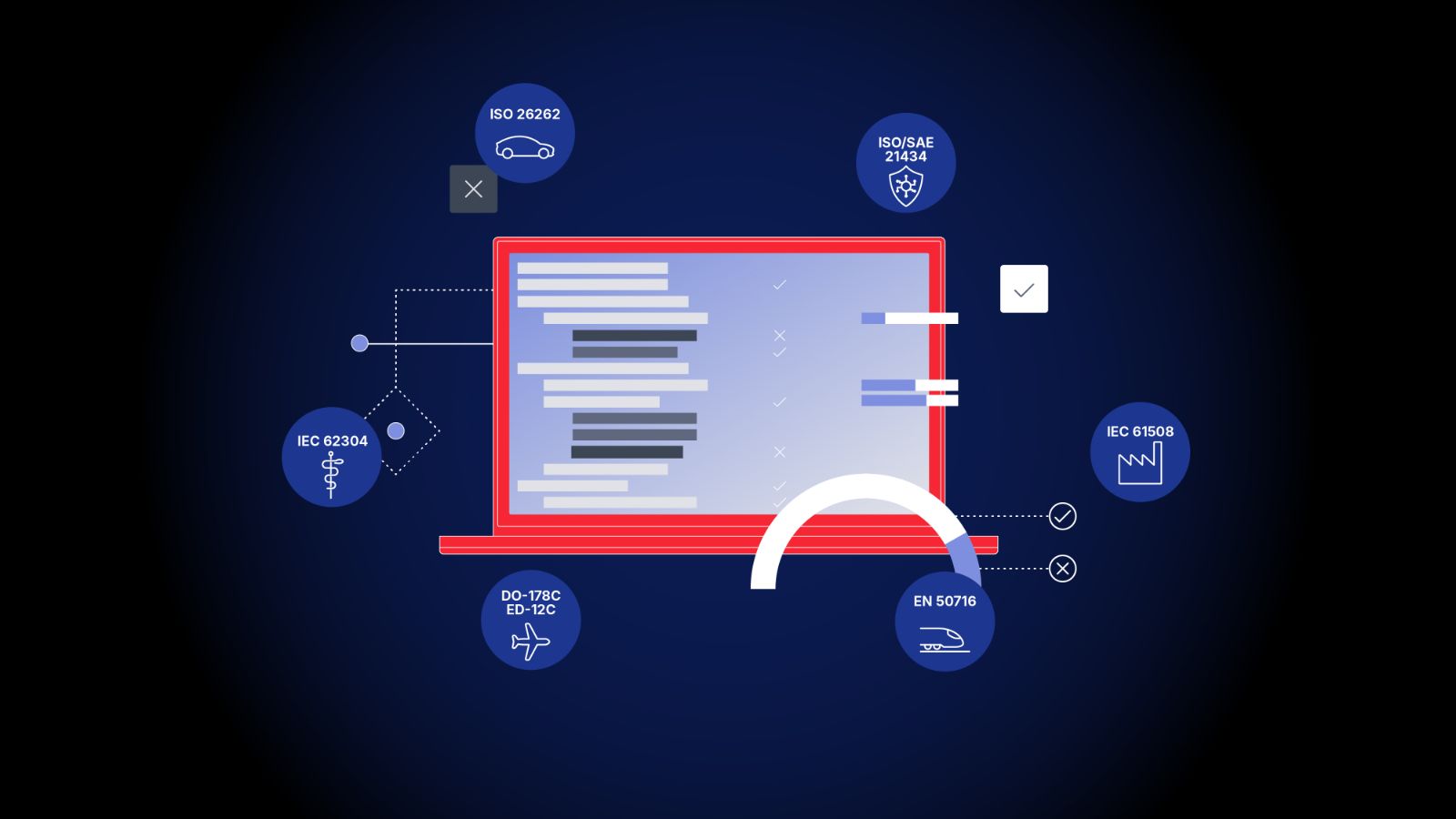
| Industry | Standard | VectorCAST | PC-lint Plus |
| Automotive | ISO 26262 | TÜV certified, ASIL A-D | exida certified, ASIL A-D |
| Aerospace | RTCA/DO-178C, RTCA/DO-330 | Tool Qualification Kit is available on request | ✗ |
| Industrial Automation | IEC 61508 | TÜV certified, SIL 1-4 | exida certified, SIL 1-4 |
| Medical Devices | IEC 62304 | TÜV certified | exida certified |
| Railway | EN 50716 | TÜV certified | exida certified |
| Nuclear Power Plants | IEC 60880 | TÜV certified | ✗ |