Model-Based System Engineering and Closed-Loop System Validation in a Software as a Product Context
Case Study Aumovio (formerly Continental)
The Customer
As a technology company, Aumovio offers the right fusion of hardware, software and services for the current and future challenges of mobility.
The Challenge
Enable model-based system engineering and closed loop system validation for a liftgate application with sufficient degree of system behavior accuracy in a software as a product (SWaaP) context based on a L1 virtual ECU (vECU). The key challenge in a SWaaP use case is to enable modelbased system engineering and closed-loop system validation with sufficient accuracy in terms of system behavior without having real hardware available. This comes with the goal of shifting efforts for system and software development, integration and validation to an earlier point within the development cycle.
The chosen approach is based on creating a virtual system equivalent that can be used for system and software development as well as closed loop system validation. Critical design parameters and challenges for the virtual liftgate system are:
- Time resolution and synchronization
- Stability of closed loop system behavior
- Equivalence of virtual and real system behavior and validation (e.g. Accuracy for Pinch Detection)
- Reuse of existing HIL models
- Complexity of software component integration into the virtual system / ECU
- Ability to perform automated tests
The Solution
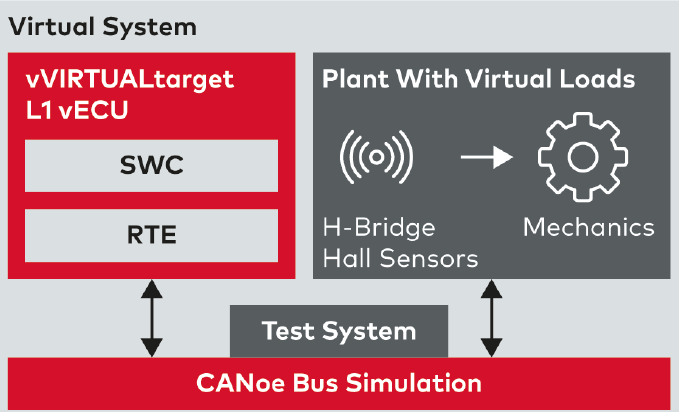
Create digital twins for every system component and connect them with each other. The real system consists of an motor control application hosted on a real target ECU and additional hardware system elements which are required to control the vehicle tailgate (e.g. motor, Hall sensor, H-bridge). In the virtual system the motor control application is hosted as a software component (MotCtrl) on a vECU created with vVIRTUALtarget. A Simulink-based plant model for the electric liftgate consisting out of an H-bridge, electric motor, mechanical simulation for the vehicle liftgate and the whole sensing part completes the virtual system. Both the vECU and the virtual plant model are integrated into and executed within a CANoe environment, reducing the effort required to link them together. The vECU and the virtual plant model are linked to each other within the CANoe simulation enviroment using a CAPL-based connection component. CANoe as the execution environment for both the vECU and the virtual plant ensures time synchronization between the different parts of the simulation.
The Advantages
Higher quality and lower costs through frontloaded software and system development, integration and validation based on the digital twin.
- Comparatively easy integration of SWC into the vECU
- Easy embedding of the plant model into CANoe
- Reusability of software components and HIL Models for the real target system
- Preparation of target hardware integration
- Closed loop testing and debugging is possible without the need of a real hardware system
- Basic system validation is possible