vVIRTUALtarget supports function and software developers, software integrators, and test engineers across the entire ECU development process.
For AUTOSAR Classic projects, vVIRTUALtarget (VTT) creates a virtual System under Test (SUT), also known as a virtual ECU, or just vECU.
Advantages
Start your vECU quickly and keep development and testing flexible.
- Create and run virtual ECUs on Windows or Linux environments
- Stimulate and monitor ECU-internal variables
- Keep real and virtual hardware configurations consistent
- Set up and test individual software components with abstracted basic software or test the entire ECU software even without target hardware (from the application software to the AUTOSAR basic software to the hardware drivers)
- Use many I/O capabilities: CAN, CAN FD, LIN, FlexRay, Ethernet, SPI, I2C, Digital I/O, PWM, ADC
Application Areas
Use vVIRTUALtarget wherever you need early validation, virtual integration, and reliable verification of AUTOSAR Classic software.
- Testing of individual software components or their interaction with the help of abstracted communication already in early phases of development
- Virtual integration of the application code and the basic software into an overall system
- Accompanying testing during design and implementation of the functional software
- Testing and verification of software integration on a virtual basis
- Verification of tests using vECUs for further use on real ECUs
Key Features
Highlights of the current release:
- Derive a Level 3 virtual ECU with just two commands from the real target configuration.
- Virtual ECUs can be used directly in CANoe, as well as in different simulation environments via OpenSUT API or the SIL Kit
- vECUs can be exported as FMU according to FMI 3.0 and ls-bus supporting CAN, Ethernet and LS-XCP.
- ECU virtualization as engineering project: We support AUTOSAR CP BSW from all vendors.
- Performance indicators are part of every virtual ECU.
- Virtualize MICROSAR.IO ECUs – Vectors lightweight stack for sensor / actuator ECUs.
Proven in Practice: Customer Success Stories and Expert Insights
Case Study Aumovio
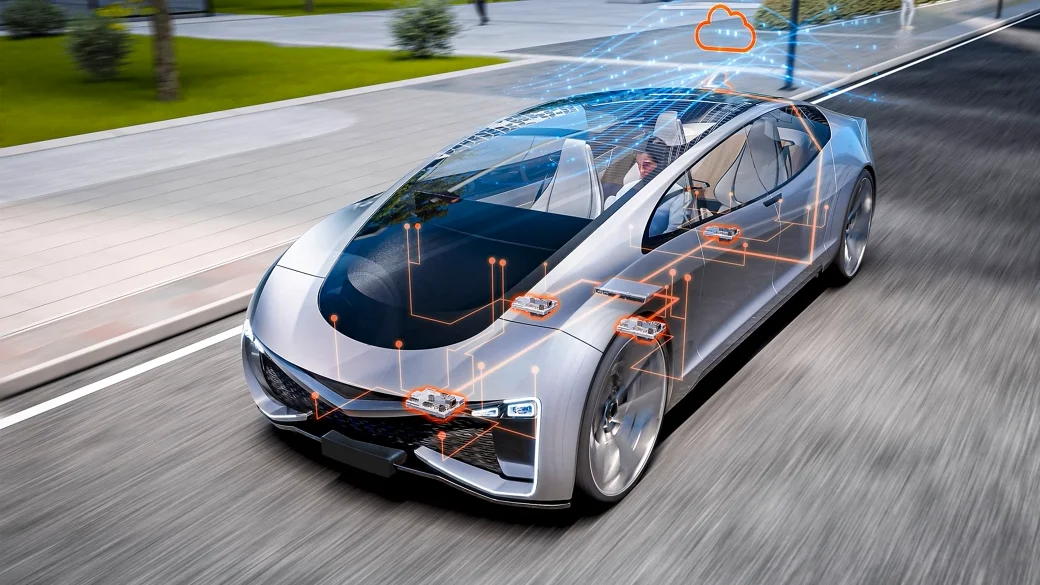
Aumovio (formerly Continental) leveraged vVIRTUALtarget to enable model-based system engineering (MBSE) and closed-loop system validation for their liftgate application. By creating digital twins for each system component and integrating them into a virtual ECU (vECU), Aumovio was able to conduct early system and software development, integration, and validation without the need for physical hardware.
Success Story Hitachi
Hitachi Astemo (formerly Hitachi Automotive Systems) has been working on virtual engine ECU and automated testing. It has implemented Vector's vVIRTUALtarget as a virtualization tool and applied it to some BSW modules that form AUTOSAR. As a result, it has succeeded in shortening the execution time of a test scenario considerably. It has also achieved other effects such as improvement in testing thoroughness and the use of the same test scenario with HILS (integration test).
AUTOSAR Classic Development Workflow
vVIRTUALtarget pro is used by software developers and integrators for virtual testing of functional software based on AUTOSAR – from first software components (SWCs) up to a real ECU ready for SOP.
In subsequent work steps, the vECUs can be executed and tested in your test environment.
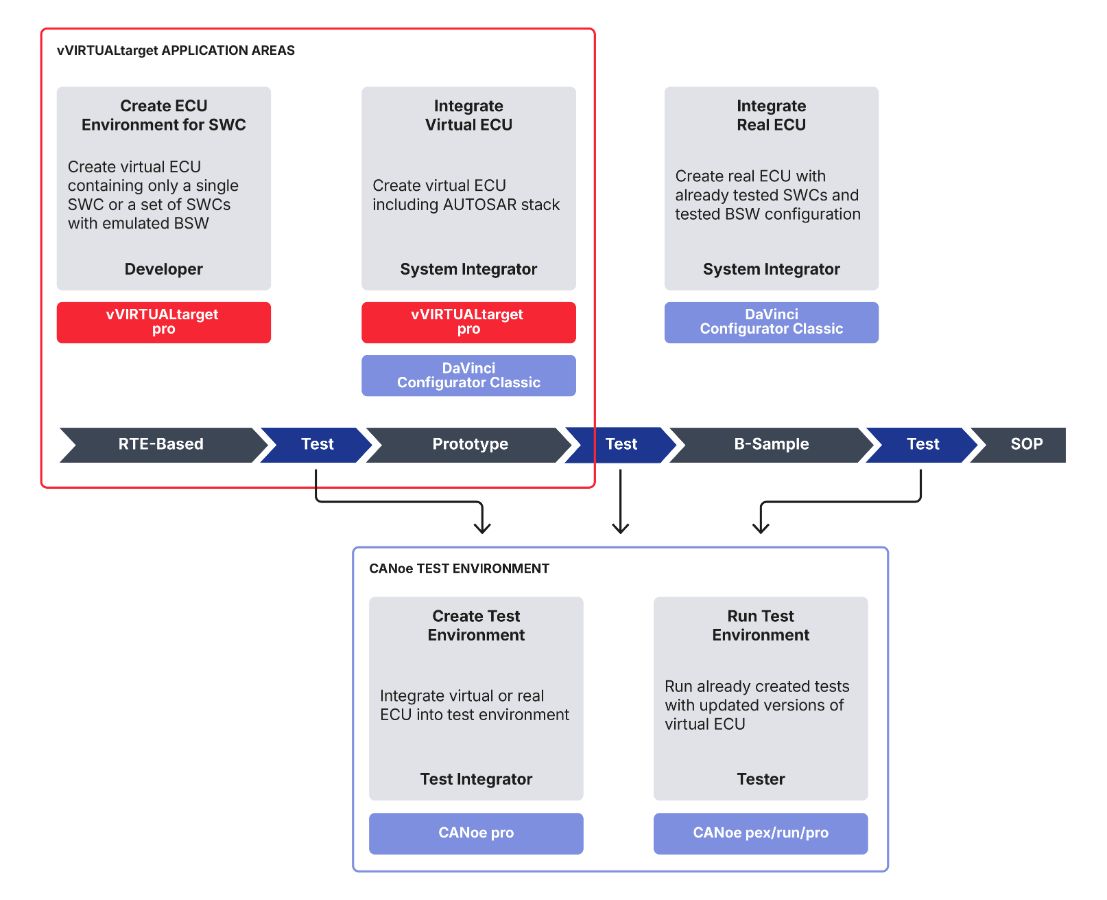
Virtual ECUs build the base for your SIL environment. We encourage you to test your ECU on different levels – and re-use the tests on each level:
- Start early with the Level 1 vECUs for the Software Component (SWC) Integration Test. Focus on the application layer and the functional behavior of the individual software components. vVIRTUALtarget generates the RTE headers, which also will be used in the final ECU. vVIRTUALtarget Level 1 vECU contains some emulated basic software services and provide management of the ECU lifecyle.
- Continue with a Level 3 vECUs and the ECU integration tests. The configuration of the AUTOSAR Basic Software, its communication and the interaction between application and basic software is in focus.
- Finally the HIL tests are used for black box testing on the integrated hardware device.
Vectors test solutions (vTESTstudio or the VS Code Extension) ensure that you can re-use most of the tests from Level 3 also for the HIL. Level 1 and Level 3 vECUs both additionally offer access via PortMonitoring or XCP to Port Instances or internal states of the ECU.
How vVIRTUALtarget Supports You in Important Development Phases
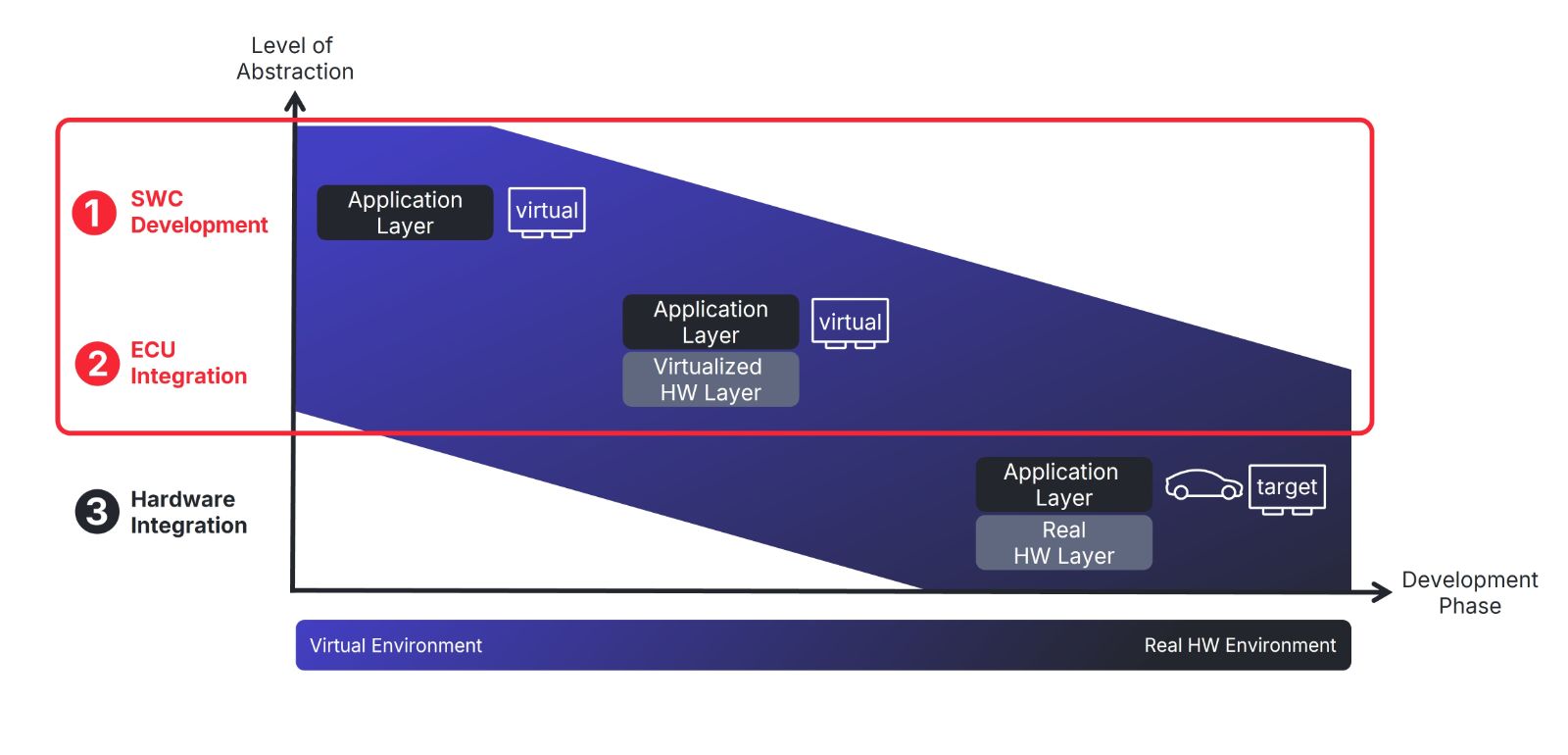
Phase 1: SWC Development: Development and Testing of AUTOSAR Software Components (SWCs) in Early Development Stages
Already in the design and development phases of AUTOSAR SWCs you can start testing your results with vVIRTUALtarget pro. It offers you the option of automatically connecting individual or multiple SWCs to an execution environment using their AUTOSAR interfaces. The typical behavior of an AUTOSAR base software is emulated by vVIRTUALtarget pro, so you do not have to worry about configuring base services.
However, vVIRTUALtarget pro also gives you the freedom to set typical services for controlling the management layer yourself. This can be, for example, the wake-up behavior of the ECU or the assignment of AUTOSAR runnables to AUTOSAR tasks. This flexible approach allows you to fully concentrate on the actual application development and test implementation:
- i.e. stimulate the inputs of your software
- observe the reaction of the software at the outputs
Phase 2: ECU Integration: Development and Testing of ECUs With Basic Software
In the next step, you test the application and the configuration of the entire ECU virtualized with vVIRTUALtarget pro:
The DaVinci Configurator Classic tool allows you to configure your basic software and reuse the non-hardware related element one-to-one for the virtual ECU. The hardware related parts are replaced for your vECU. However, a reconfiguration or even a new configuration is not necessary, because the virtual elements are derived from the real parts. The result is a binary file that you can use in your PC execution environment, for example in CANoe. Your test interfaces are, here analog to real ECUs, the network messages and I/Os.
In addition, the vVIRTUALtarget pro variant offers you the possibility to:
- stimulate and observe AUTOSAR port interfaces that are not assigned to bus signals
- or to connected to other software components.
- In addition, it provides you the possibility to monitor closed port connections.
The created vECU can be tested alone, in combination with other vECUs or in combination of real and virtual ECUs to test an entire system. With a variety of supported standards, the vECUs can be integrated easily into different execution environments:
- Directly into CANoe
- Via the OpenSUT API, which is automatically integrated into every vECU and allows to access and control the complete vECU
- Pre-integrated with the SIL Kit
- As Functional Mockup-Unit according to FMI 3.0 and ls-bus
You no longer need a dedicated virtualization tool for AUTOSAR Adaptive. Interacting with AUTOSAR Adaptive applications is easily achievable with the free and open-source SIL Kit.
Product Description
vVIRTUALtarget pro supports you in creating vECUs in your AUTOSAR Classic applications.
| Development Phase | vECU Level1 | Test Focus |
| Software component (SWC) integration | Level 1 | Virtual functional SWCs |
| ECU integration | Level 3 | Virtual ECUs |
| Access to open RTE ports + port monitoring | ||
| Functional system integration | Level 1 | Functional interaction of several SWCs |
| System integration | Level 3 | Complete system with virtual and real ECUs |
1) According to prostep ivip White Paper Smart Systems Engineering, Requirements for the Standardization of Virtual Electronic Control Units (V-ECUs), 2020
Downloads
Related Pages