Success Story Mercedes-Benz: Automated Testing in the Cloud
Enabling SDV Innovation Through Server-Based Automated Testing

Virtual test platforms and automated test processes are becoming increasingly important. This success story highlights the successful use of a CI/CD pipeline in combination with CANoe Server Editions to make development and test processes at Mercedes-Benz more efficient and scalable in cooperation with its suppliers.
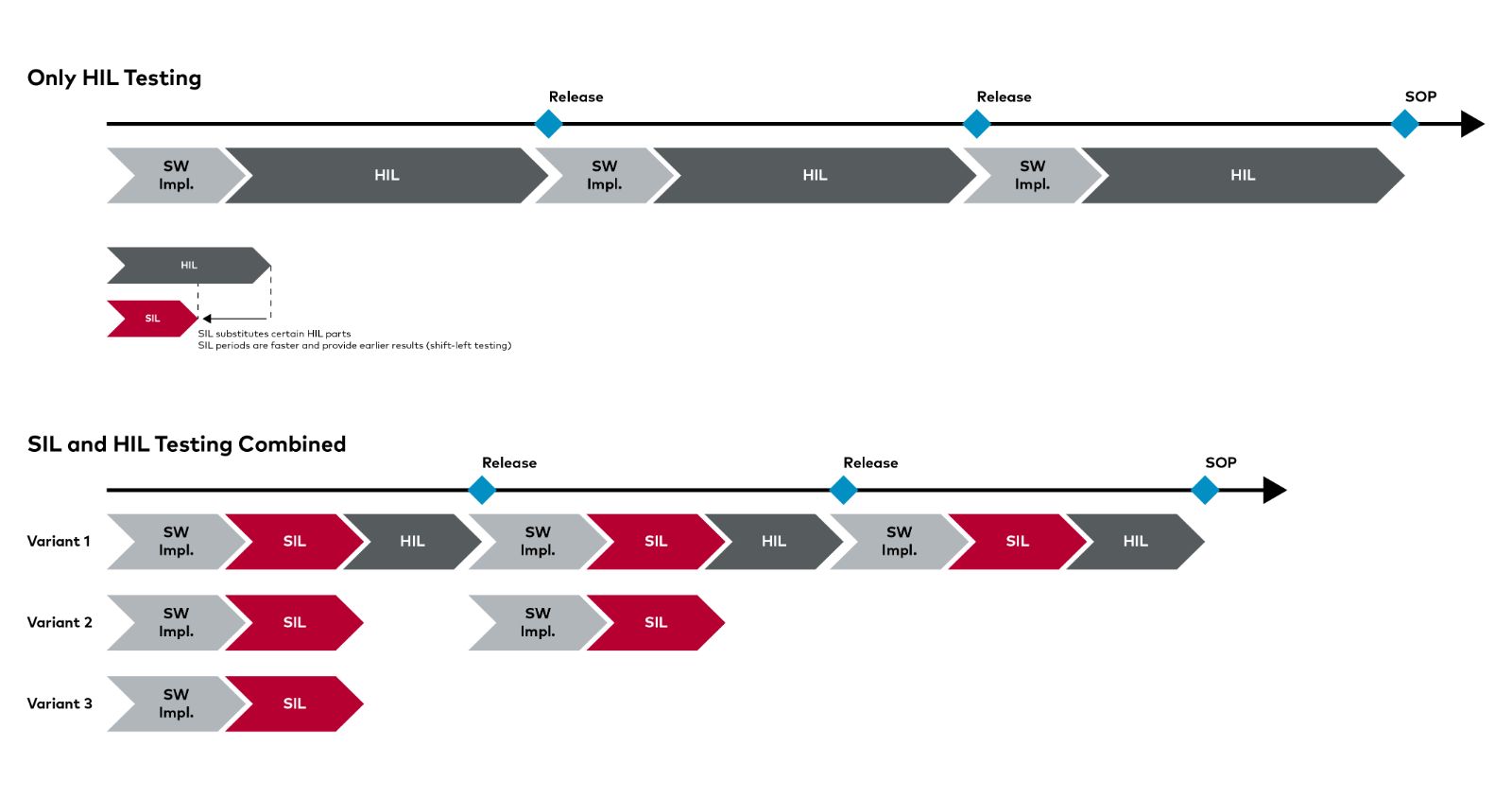
Due to the increasing complexity and variety of modern vehicle functions, the need for flexible, software-based architectures such as those embodied by the softwaredefined vehicle (SDV) is also growing. With an SDV, innovative features and services can be agilely deployed, continuously updated, and delivered. The growing complexity and diversity of modern vehicle systems are increasingly challenging traditional, hardware-based integration and testing platforms. Their reliance on physical components makes scalable and timely validation difficult. By virtualizing ECUs (vECUs), this hardware dependency is significantly reduced—enabling more flexible, efficient, and scalable testing workflows. Virtual ECUs, acting as digital twins, enable flexible and early integration into virtual test environments. At the same time, tests can be parallelized with virtual ECUs and executed much faster, which is an essential advantage over hardware-based setups (see Figure 1). In addition to advancements in vehicle development, the Cyber Resilience Act requires companies to provide a thorough analysis and concrete countermeasures within 72 hours of a security incident. This requirement increases the pressure on development departments to establish automated and reproducible test procedures in order to be able to react quickly to detected security threads. Automated tests enable immediate validation of fixes and ensure that security vulnerabilities are addressed efficiently and without delay.
Efficient Testing Processes Through Virtual Platforms
In the past, Mercedes-Benz had to wait for suppliers to deliver final hardware samples before testing could begin. This caused delays in the validation process and reduced flexibility in testing software components. The vTesting platform represents Mercedes-Benz’s strategic response to the challenges outlined above. Initially launched as a proof of concept in 2020, it has since evolved into a wellestablished component of the company’s testing infrastructure. Today, it plays an integral role in the development process, enabling reliable and scalable protection of complex software functions.
Software Testing Without Hardware: Shift Left With vTesting Platform
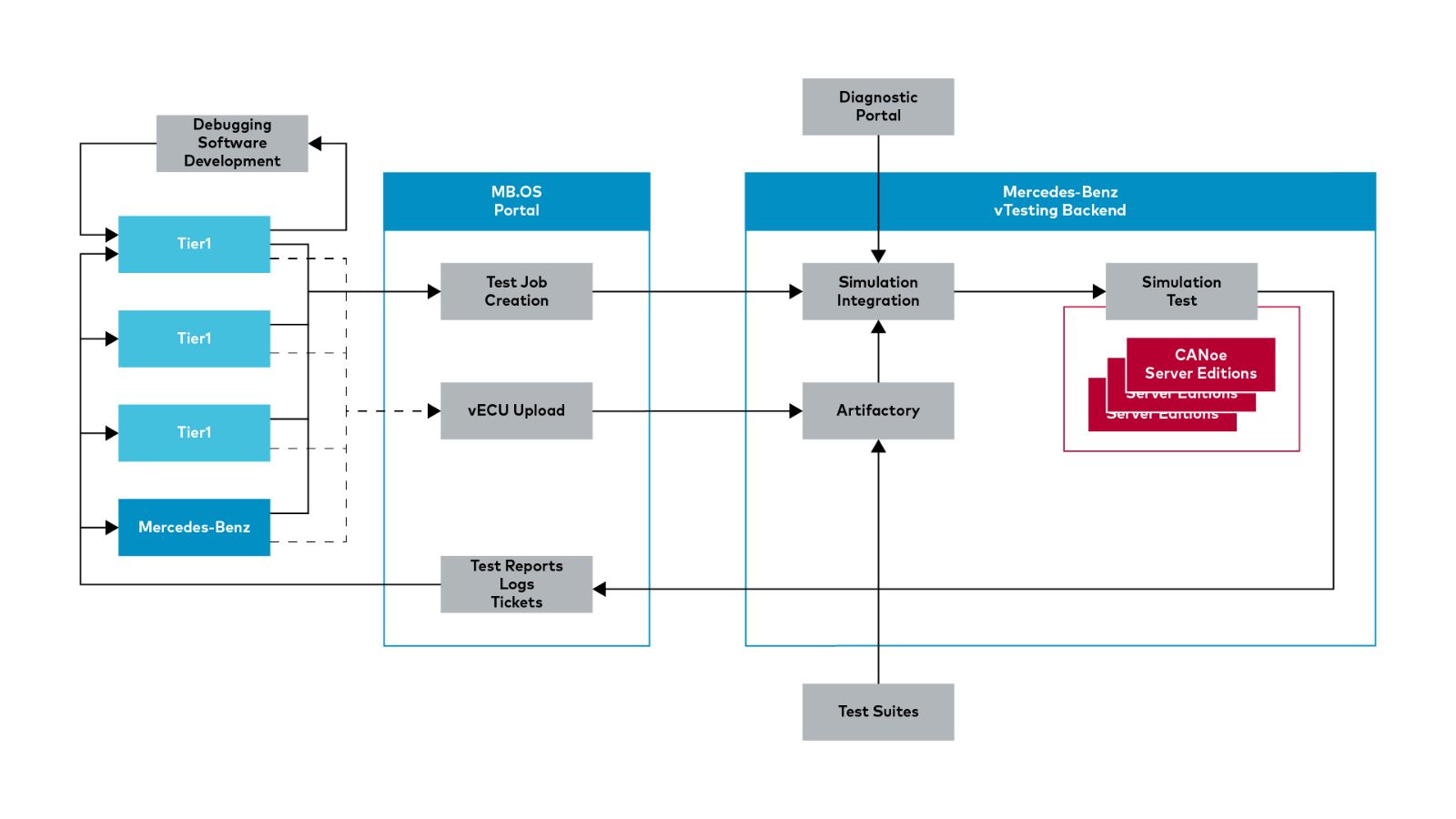
The vTesting platform enables early testing of the full supplier software stack in a software-in-the-loop setup, long before physical hardware becomes available (see Figure 2). Through the MB.OS Portal, both Mercedes-Benz and its suppliers can independently upload and access the latest software versions, ensuring seamless collaboration and faster validation. The upload process can be fully automated through API integration, allowing software versions to be pushed as part of a commit or merge request in the CI/CD pipeline. The simulation includes virtual ECUs generated using vVIRTUALtarget or Synopsys Silver, a range of test cases, and diagnostic data sourced directly from the portal. Both the configuration and the test scenarios are dynamically generated based on the vECU and additional metadata. Standardized tests for diagnostics, security, and bus systems, along with functional checks, are executed to enable developers and testers to quickly access and apply predefined test cases. Mercedes-Benz mandates the use of virtual ECUs to all suppliers making these a key element of the procurement process. The test environment is configured according to the “everything as code” principle, ensuring transparent traceability and consistent versioning of all settings and processes. By running several CANoe Server Editions in parallel, the DevOps pipeline provides a robust foundation for scalable, efficient, and hardware-independent validation and protection of complex software systems. The centralized infrastructure also enables cross-departmental license sharing, allowing license costs to be distributed efficiently across multiple teams.
Advantages Through Early and Automated Software Testing for Suppliers
Suppliers benefit greatly from the shared use of the vTesting platform. Integrated into Mercedes-Benz’s CI/CD pipeline, they are able to conduct integration and acceptance tests efficiently and with high reliability. The link to the virtual test environment enables early-stage validation, significantly accelerating development cycles and improving overall collaboration. The test environment plays a central role in the early detection and resolution of hardware problems or bottlenecks, effectively avoiding downtime. By uploading their current software version independently and having automated tests carried out, suppliers receive early feedback on the maturity level of their software. Fast access to test results enhances code quality, minimizes rework, and fosters continuous software development within agile teams. In most cases, generating vECUs does not require significant additional effort. Thanks to the dual-target concept, virtual and physical ECUs are maintained consistently. Additionally, Vector can deliver vECUs virtualized with vVIRTUALtarget to suppliers and OEMs for specific use cases.
Ready for Software-Defined Vehicles and Agile Development
The introduction of the vTesting platform marks an essential step toward accelerating and increasing the flexibility of development and testing processes in the automotive software environment. Mercedes-Benz and its suppliers benefit from early, automated quality assurance and the ability to validate software independently of physical hardware. Internal analyses at Mercedes-Benz have shown that, depending on the test suite, software-inthe-loop (SIL) tests using vECUs can achieve up to 95 % correlation with tests performed on physical hardware. It helps accelerate development while ensuring that issues are identified and resolved at an early stage. Ongoing development of virtual testing technologies will further enhance agile workflows and software validation for SDVs, positioning companies for success in the evolving digital competition.