
Simulation, Analysis, and Automated Testing of SCI-XX/RaSTA Systems
The "Railway Signalling Add-On" extends the CANoe testing tool to include SCI-XX/RaSTA interfaces. These two communication protocols are used in digital railway signalling. With the add-on, you can simulate, analyze, and test the SCI-XX/RaSTA interfaces in your system. Using CANoe, you facilitate validation and verification from individual elements of railway signalling systems to extensive networks.
Advantages
- Reduce development and integration risks through realistic simulation of object controllers, field elements, interlocking systems, and adjacent systems for EULYNX and NeuPro interfaces – long before the actual infrastructure is available.
- Test under real-world conditions through seamless integration of the simulation into real SCI/RaSTA networks. This enables consistent interaction between real and virtual components.
- Full transparency regarding communication, as all telegrams and messages from both real and simulated participants are fully monitored, traced, and analyzed.
- Increased robustness and safety of your systems through targeted analysis of edge cases and error states, as well as validation of behavior under optimal and worst-case conditions via controlled error injection.
- Flexible customization of your tests for every project phase, from simple functional tests to complex, realistic end-to-end scenarios in railway signalling – for more efficient testing and faster project feedback.
Application Areas
- Exploratory Testing: With the Railway Signalling Add-On for CANoe, you establish communication with your system under test. With just a few code lines, you send standard-compliant SCI telegrams and RaSTA messages and analyze the data you receive. In combination with additional test hardware, you can time-synchronously stimulate and analyze analog, digital, and serial interfaces as well as a variety of network interfaces of your system. This allows you to detect errors already in early development phases.
- Conformity Testing: The Railway Signalling Add-On enables comprehensive testing of the PDI, BTP, RaSTA, and OPC UA protocols for testing the SCI, SDI and SMI interfaces. This includes sending application data and analyzing the response of the system under test. Thanks to the support of a wide range of additional communication protocols, CANoe simplifies the implementation of debug interfaces. With these, you implement test cases that would otherwise be impossible to execute.
- Security Testing: CANoe contains functions for fuzz and penetration testing, which you use to test components that must meet high security standards. In addition, CANoe simplifies the testing of TLS encryption.
- Integration Testing: The high scalability of simulations in CANoe enables integration tests of multiple components in large networks, such as train stations and long track sections. Through CANoe’s support for various other protocols and I/Os, you stimulate and analyze every interface of every participant – not just SCI and RaSTA.
- End-Of-Line and Acceptance Tests: Finished individual components can be comprehensively tested with CANoe. You implement environmental simulations, test cases, and hardware access to the system under test in a single tool. This simplifies automated testing of all interfaces.
Features
CANoe already contains a vast number of native functionalities for simulation, stimulation, analysis, and testing. The Railway Signalling Add-On offers the following additional features:
- Support for the PDI (EULYNX, Baseline 4 Release 3) and BTP (NeuPro, Release 3 Version 3) application layers in CANoe. This allows you to simulate, analyze, and test applications based on the SCI-XX protocol stack. This includes the SCI connection handshake for NeuPro subsystem interfaces and EULYNX interfaces, as well as the data model for the telegrams defined in the EULYNX interfaces SCI-P, SCI-LS, SCI-LC, SCI-TDS, SCI-IO, SCI-LX, SCI-ILS, and SCI-RBC.
- The integrated underlying RaSTA protocol (DIN VDE V 0831-200) supports multiple transport channels based on UDP, TCP, and TLS (versions 1.2 and 1.3).
- Monitoring of all sent and received SCI telegrams, RaSTA messages, and Ethernet frames, as well as insight into the state parameters of the SCI and RaSTA stacks.
- In-depth testing of the RaSTA protocol layer using a pre-built test framework that simplifies test design and implementation according to exhaustive requirement specifications.
- Error injection at the application (PDI and BTP) and RaSTA layers to perform comprehensive conformance tests.
- Straightforward means of implementing additional user-defined application layers based on RaSTA or SCI.
- Simulation of OPC UA servers and clients to test their respective counterparts, for example, for the SDI and SMI interfaces of EULYNX and NeuPro systems.
Early Testing – A Use Case
To ensure compliance and interoperability, it is crucial to begin testing early in the development process. This is typically done through simulation within the CANoe test tool and subsequent analysis of the responses from the system under test (SUT).
For example, an object controller for a point is tested in CANoe through simulation of an interlocking and a point motor. The configuration parameters for the interlocking, such as SCI IDs, RaSTA IDs, etc., and the digital I/Os of the point motor are specified in the test tool. CANoe then sends the corresponding SCI telegrams from the simulated interlocking and verify the object controller’s response. By simulating the involved participants – i.e., the SUT’s environment – the correct behavior of the object controller to both interfaces can be verified without requiring the real counterparts.
Additionally, this test can also be performed on the virtualized software of the object controller. In this case, no hardware is required, drastically minimizing the costs and effort associated with early testing.
Take Advantage of All the Benefits of CANoe
Vector has many years of experience in system-level testing and uses this expertise to support the railway industry in the development of complex networks and their individual systems. For this reason, we have developed the Railway Signalling Add-On for CANoe to analyze, simulate, and test the SCI-XX/RaSTA interface in accordance with EULYNX and NeuPro.
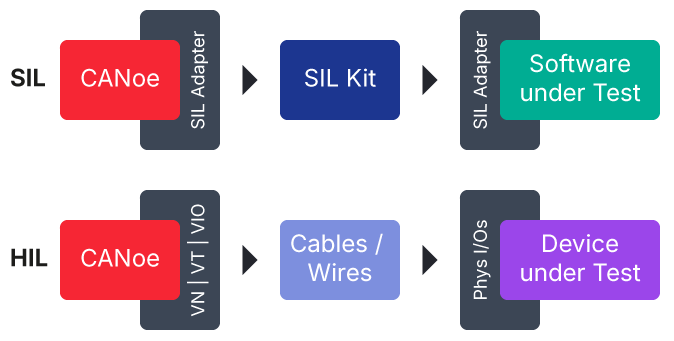
CANoe simplifies automated testing in virtual and real environments. Thanks to a wide range of software and hardware interfaces, data exchange is possible with any system under test. The VT System and VIO System handle data exchange via analog, digital, and serial I/Os. In addition, Vector’s VN Interfaces enable network communication with the SUT. This allows you to test various interfaces such as EtherCAT, MQTT, CAN, CANopen, SPI, and I2C.
For testing in virtual environments, i.e., Software-in-the-Loop testing, the SIL Kit is used for data exchange with the software under test. CANoe contains pre-built Graphics windows for analysis and easy interaction with the system under test. You can also create user-defined panels for your specific use case.
For clear traceability, link test cases within vTESTstudio to the requirements managed in ALM tools. You achieve an even higher degree of automation when the test cases are executed in CI environments.

Related Products
Railway Systems Engineering
CANoe