Sensor Simulation
Environment Perception for ADAS Using Virtual Sensors for Camera, Radar, Lidar, and Ultrasonic Sensors
The detection of the environment builds the basis for assisted and automated driving (ADAS/AD). For the development and testing of driving functions, the vehicle and environment simulation software DYNA4 provides proven models of camera, radar, lidar, and ultrasonic sensors.
Different Abstraction Levels
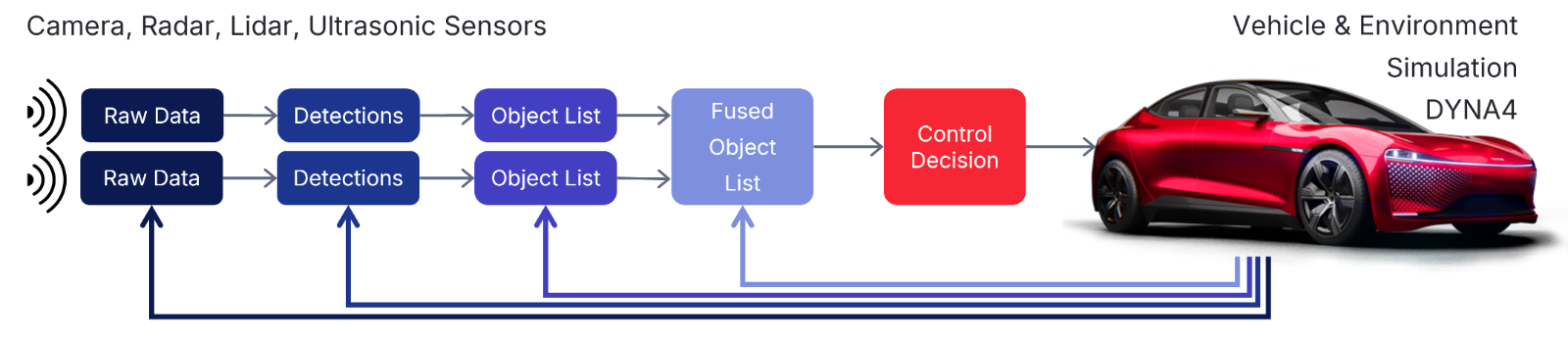
The virtual test driving software DYNA4 provides simulated sensor input with different level of abstraction. You can switch between the different levels, depending on your use case and the boundaries of your system under test:
- Sensors with physics-based raw data
Test your perception algorithm with virtually generated camera images or lidar point clouds - Sensors on detection level
Test of low-level sensor fusion algorithms with detections from multiple sensors such as radar, camera and lidar - Object lists from sensor outputs
Test of high-level sensor fusion algorithms with object lists from multiple sensors such as radar and camera - Fused object lists
Test of ADAS/AD functions with a fused object list as an input
Advantages of Virtual Sensors
- Full vehicle evaluation
Closed-loop simulations for tests of perception and control functions with consistent feedback in contrast to setups with recorded data - Flexibility for early development stages
The virtual sensors allow change of various parameters, when the real sensor setup is not yet fully defined - Riskless testing
Easily re-create challenging scenarios in the virtual world that are hard to observe in reality or pose safety risks - Exactly the right inputs
Choose the level of abstraction matching the input to your system under test - from raw sensor data to fully idealized object lists - More efficiency, less manual work
Full availability of ground truth information renders manual labelling unnecessary
Typical Use Cases
Testing BASELABS Dynamic Grid with Virtual Test Drives in DYNA4
- Determine the sensor configuration
in early development phases - Functional testing
e.g. with object-list input from NCAP collision scenarios to an automatic emergency braking algorithm deliberately neglecting the influence of the perception - Robustness testing
e.g. test the ability of an automatic parking function with degraded camera frames due to a soiled lens - Performance testing
e.g. evaluate the capability of an automated driving function with regards to functionality and timing in a HIL setup with injected camera images and radar detections - Dataset enrichment
for learning and testing of AI-based perception algorithms with scenarios, objects and environmental effects that are hard or unsafe to observe in reality
Sensor Inputs on Object Level
- Object list in DYNA4 with semantic image segmentation
- Sensor-specific object lists or fused object list
- Idealized ground-truth information or consideration of occlusion
- Highly efficient computation based on bounding-boxes or semantic image segmentation with consideration of exact geometries
- Provide simulated sensor data in ASAM OSI format for easy integration with your system under test
Simulated Sensors: Camera, Radar, Lidar, Ultrasound
Testing Camera-Based ADAS Functions with DYNA4
Cameras
- Configurable cameras with opening angles up to 360°
- Distortion parameterization with Fisheye, OpenCV, Scaramuzza or Kannala-Brandt parameters
- Filters: Dirt on lens, grayscale, Bayer etc.
- RGB image streams on separate outputs for image injection, even for stereo cameras
- Streaming of RGB camera images for video injection to ADAS control units
- Usage from MiL (algorithm development) to HIL (image injection on ECU)
Radar
- Multiple radar detections per object with radar-specific data such as distance, radial velocity and RCS provided as OSI Sensor Data
- Modelling based on Doppler effect and Fast Fourier transform (FFT) processing with resulting binning
- Coverage of typical effects like the occlusion by other objects, the antenna pattern, a limited number of detections per cycle, angle and velocity ambiguities
- Computationally efficient phenomenological model developed with Persival's expertise
Lidar
- Reflection intensity based on angle between laser beam and object surface and its material properties
- Availability of rotating and non-rotating lidar sensors
- Opening angle and signal resolution adjustable
- 3D point cloud output as ROS Topic via DDS or via UDP in Velodyne format
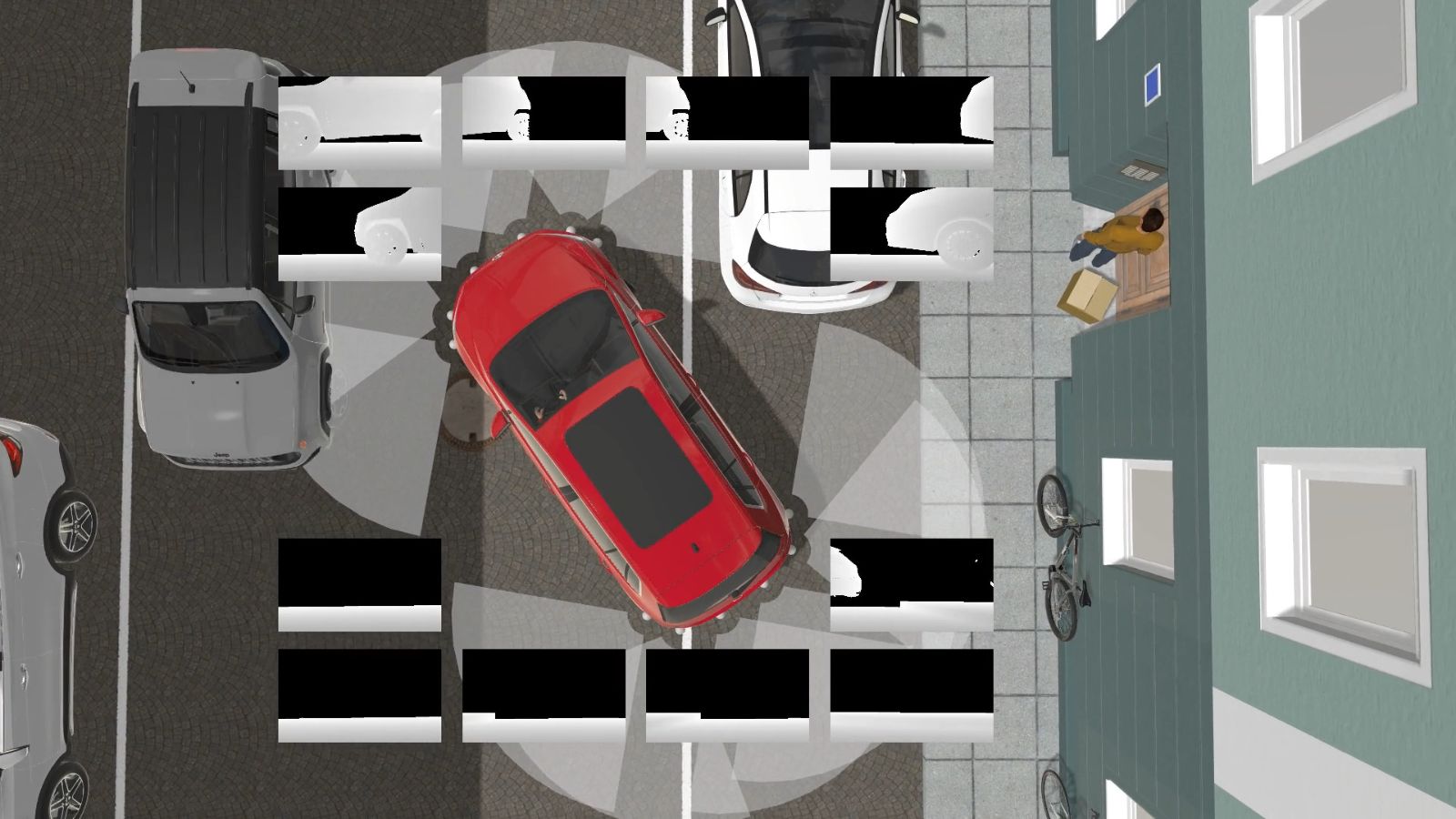
Ultrasound
- Consideration of propagation and atmospheric attenuation
- Absorption and reflection based on object geometry and material properties
- Adjustable opening angle and signal resolution
- Output of an intensity depth histogram

Felix Beygang
Expert for ADAS Solutions
Let's Discuss Your Use Case
Contact me to find the right solution if you have questions about ADAS test systems, physical simulation models, or virtual test drives.