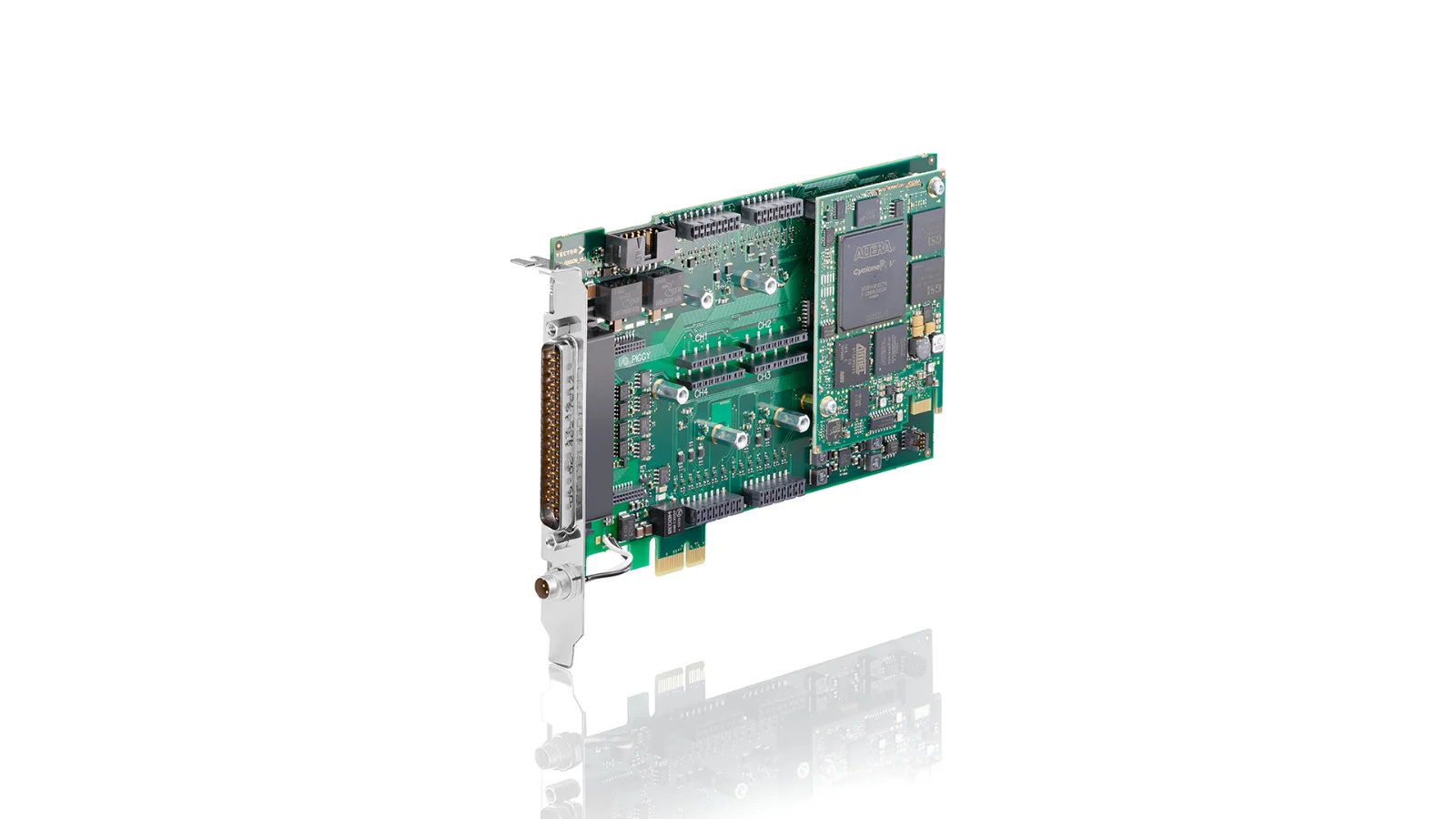
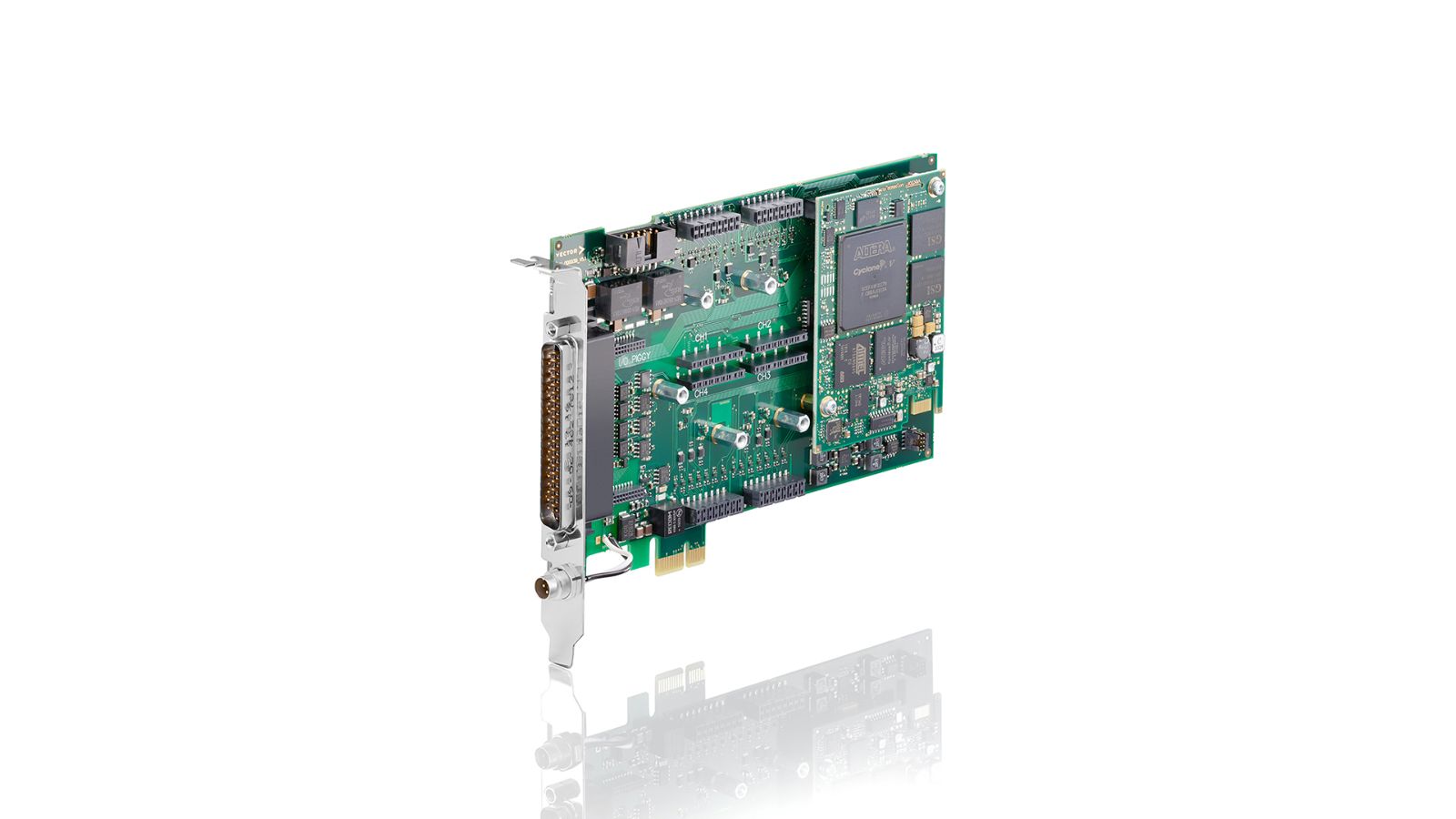
The VN7572 FlexRay network interface is designed for the development, simulation, and testing of FlexRay networks via the PCIe interface.
Versatile channel combinations for FlexRay, CAN FD, and LIN (K-line) make the interface a powerful solution for laboratory environments and engineering workstations.
Highlights
- Efficient simulation of large networks: 2 MB send memory allows parallel configuration of more than 1000 FlexRay messages.
- Autonomous FlexRay cluster startup: Enables a cold start of the FlexRay cluster without requiring an additional network node.
- Detailed startup analysis: An independent monitoring unit enables precise analysis of network startup behavior.
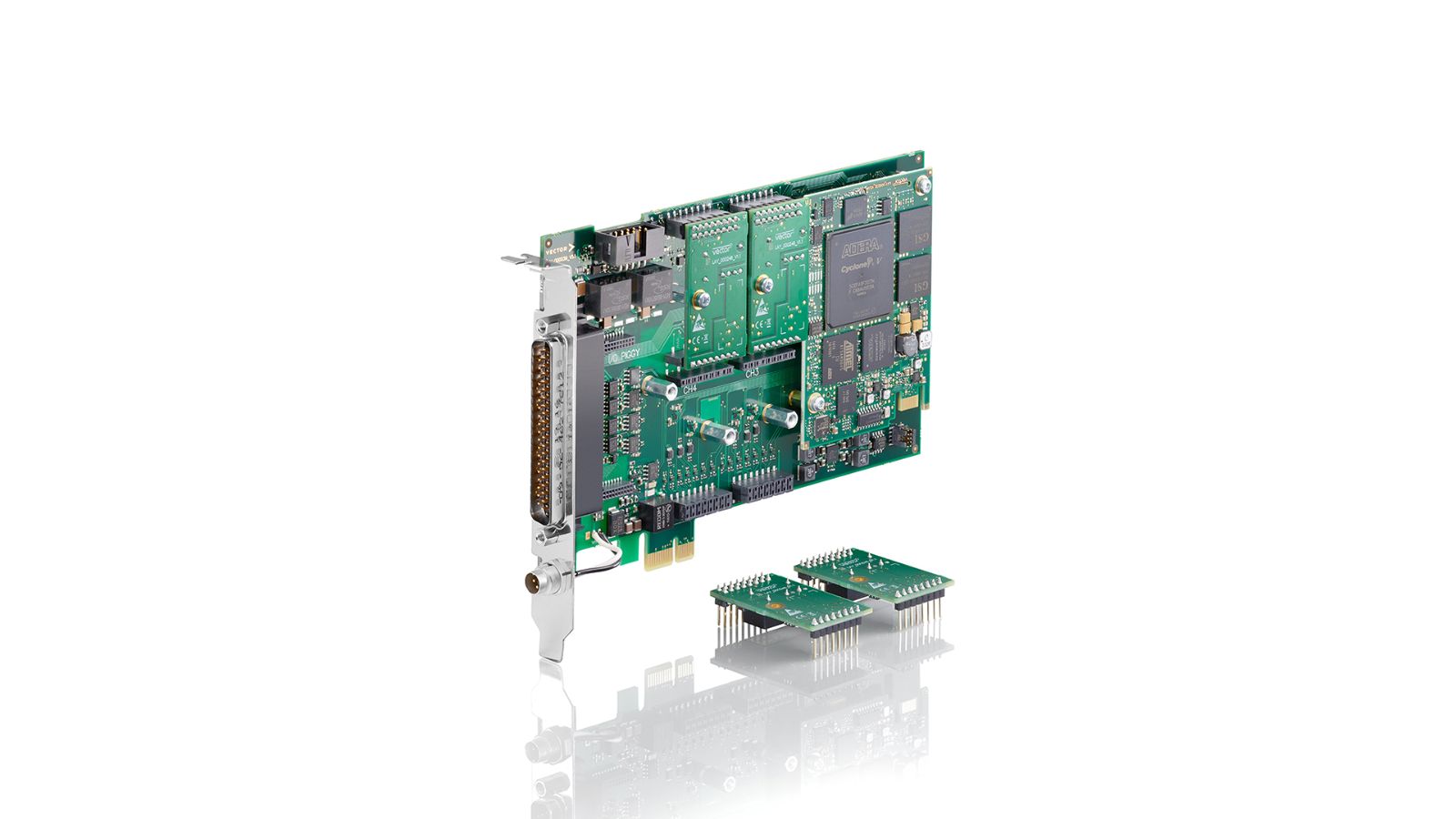
- Flexible bus combinations: Interchangeable transceivers support versatile combinations of FlexRay, CAN FD, and LIN bus physics.
- High tool performance: Optimized for CANoe, CANape, and CANalyzer applications with access to CAN, CAN FD, FlexRay, LIN, J1708, and K‑Line.
Main Application Areas
Flexible Analysis of FlexRay Networks and ECUs
The VN7572 supports flexible analysis of FlexRay networks and ECUs in combination with CAN FD and LIN (K-line).
Precise Time Analysis
The VN7572 enables precise time analysis of communication data.
Analysis and testing of ECUs and gateway applications
The VN7572 is suitable for analyzing and testing ECUs and gateway applications.
Measurement and calibration via XCP
The VN7572 supports the measurement and calibration of ECUs via XCP (XCP on FlexRay, XCP on CAN).
Functions
FlexRay
- Dynamic reconfiguration of CC buffers.
- Sending and receiving data and null frames.
- Detection of invalid frames.
- Cycle multiplexing.
- In-cycle response.
- Hardware-based incrementing of a payload range.
- PDU support.
- FlexRay gateway (channels A and B).
- Startup + asynchronous monitoring detects FlexRay frames and symbols before the communication controller is synchronized to the bus.
General
- Synchronization with multiple devices and with other bus systems (e.g., CAN/CAN FD, LIN).
- Low PC load due to Direct Memory Access (DMA).
- Very short latency times.
- Support for CAN FD up to 8 Mbit.
- Fast CAN flashing via hardware-based flash sequence support.
- Advanced LIN stress functions, e.g., for LIN 2.1 conformance tests.
- CAPL on board for CAN and FlexRay
Gallery
Technical Data
| VN7572 | |||
| Channels / channel combinations | FlexRay | CAN FD | LIN/K-Line |
| 1 | 7 | - | |
| 1 | 6 | 1 | |
| 1 | 5 | 2 | |
| 2 | 6 | - | |
| 2 | 5 | 1 | |
| 2 | 4 | 2 | |
| - | 8 | - | |
| - | 7 | 1 | |
| - | 6 | 2 | |
| - | 5 | 3(3) | |
| - | 4 | 4(3) | |
| Transceiver(1) | FR-, CAN(FD)-, LINpiggies, analog/digital IO functionality with IOpiggy available (1) | ||
| FR Comm.Controller analysis FR Comm.Controller startup | Bosch E-Ray (FPGA) Bosch E-Ray (FPGA) | ||
| Send memory | 2MB | ||
| FlexRay Cluster (A+B) | 2 | ||
| PC interface | PCIe | ||
| Trigger (inputs/outputs) | 1 (with FRpiggy 1082cap) | ||
| Analog/digital IO functionality | I0piggy8642 digital: 8 inputs, 6 outputs / analog: 4 inputs, 2 outputs | ||
| Connector | 1 x D-SUB62(2) | ||
| Power consumption | 7 W | ||
| Operating systems | Windows 10 (64 bit) / Windows 11 (64 bit) | ||
| Temperature range, operating: storage | -30...+50°C -40...+85°C | ||
| Dimensions (LxWxD) | 181 x 127 x 22 mm |
(1): Detailed listing of all transceivers see the transceivers overview
(2): Breakoutbox or 9-fold Y-cable with 8 x D-SUB9 (FlexRay, CAN(FD), LIN) and 1 x D-SUB15 (IO) as accessory available
(3): max. 2 x K-Line channels available
Product Descriptions
| VN7572 User Manual (PDF) |
Related Products