
SOVD - Service Oriented Vehicle Diagnostics - ISO17978-3
With the introduction of powerful high-performance computers (HPCs) and the shift toward Software-Defined Vehicles (SDVs) featuring increasingly software-based systems, the requirements for vehicle diagnostics are also changing.
Heterogeneous operating systems, numerous parallel processes, and the high rate of software changes – and therefore changes in diagnostic scope – are presenting new challenges for traditional diagnostic methods.
One Standard – Three Scenarios: SOVD in Modern Automotive Diagnostics
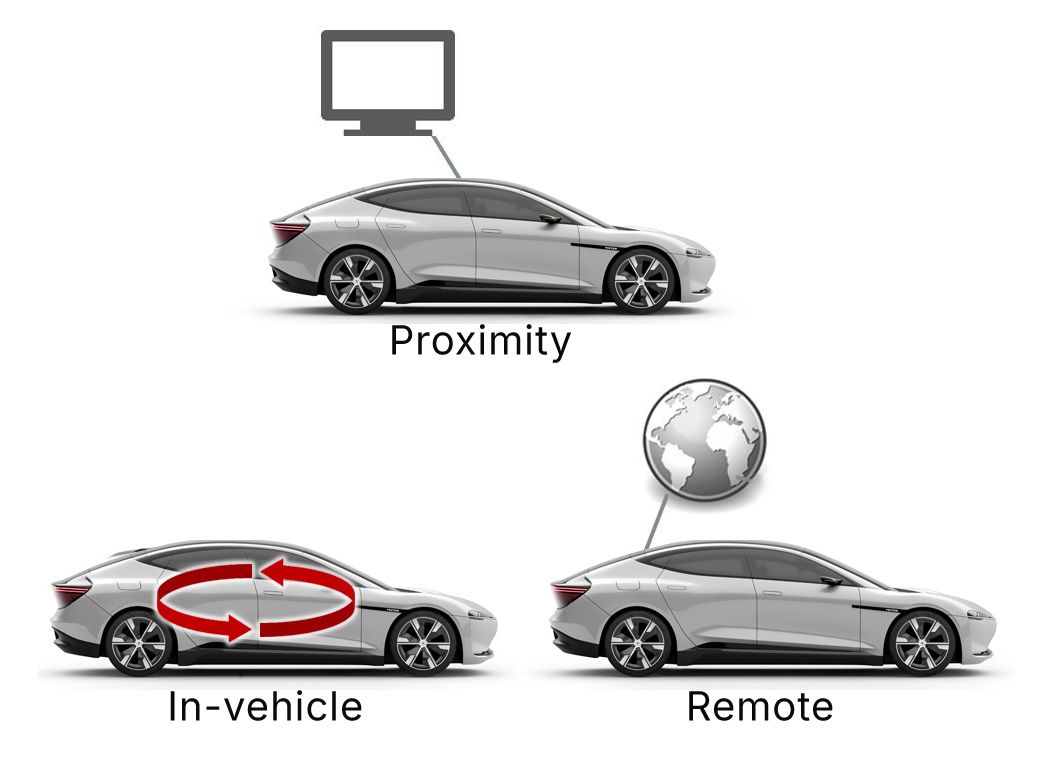
To meet the new diagnostic challenges, the standardization of SOVD v1.0 in ASAM laid the foundation for simple and modern diagnostic access. This covers access to both classic ECUs and also to new software-based systems.
The standardization of SOVD as ISO17978-3 adds further features for the diagnostics of software-defined vehicles. By using http REST as its base technology, SOVD provides smart access for various application scenarios such as Remote, Proximity, or In-Vehicle Diagnostics.
This allows SOVD to establish the ideal foundation for future-proof, flexible, and standardized vehicle diagnostics that meet the growing demands of modern vehicle architectures.
Diagnostics for Software-Defined Vehicles (SDVs)
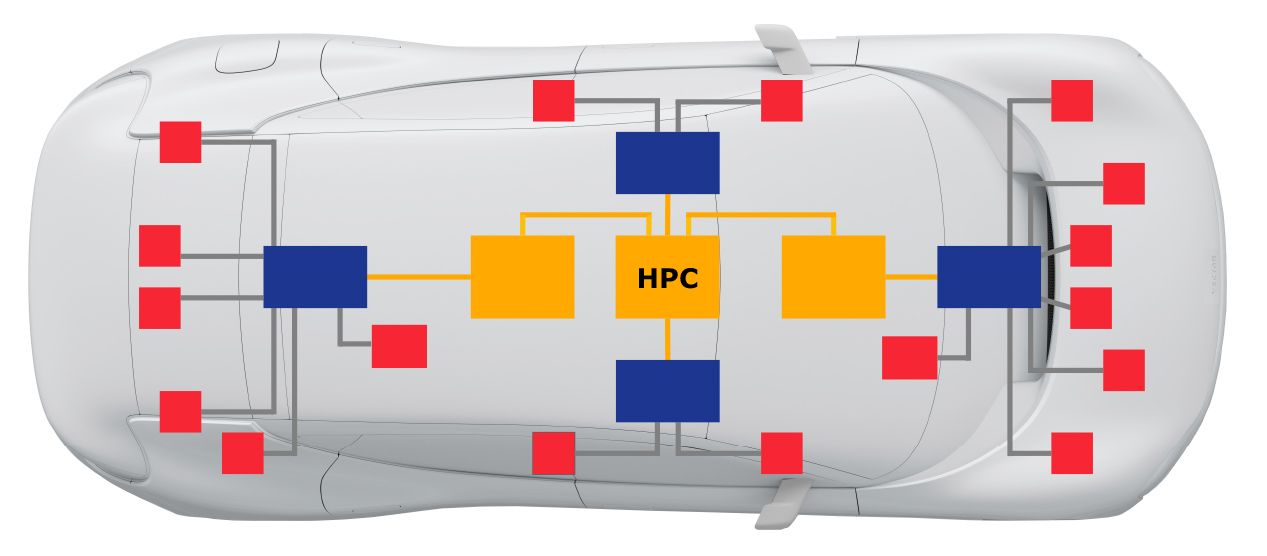
The trend towards the Software-Defined vehicle (SDV) imposes major changes on the in-vehicle architecture.
The shift towards zonal architectures provides an abstraction from the basic hardware layer. This allows to provide customer features based on individual software modules (apps). With that, the focus of diagnostics extends to diagnosing also software and thus diagnosing Software-Defined vehicles.
The SOVD standard has set itself the goal of providing "an API for diagnosing Software-defined Vehicles". To achieve this goal, the standard introduces a palette of features such as:
- Self-describing API to reduce dependencies to off-board clients.
- New use-cases with focus on microprocessors to speed up SDV development.
- Stateless communication based on REST to enable native backend integration.
- State-of-the-art IT technologies such as HTTP, OpenAPI, OAuth to lower the entry barrier for engineering and to accelerate development.
Developed as a standard for SDVs, SOVD – together with an end-to-end software factory and a flexible E/E architecture – forms the foundation for modern, continuous software deployment in vehicles – from development to over-the-air updates.
This integration makes the development, testing, and rollout of new vehicle functions more efficient and creates the conditions for a true, continuously evolvable Software-Defined Vehicle.
Know-How
SOVD Standardization
Vector’s SOVD solutions ensure your compliance with SOVD standards at all times, while also giving you the flexibility to design development processes that are faster, more modern, and future-oriented.
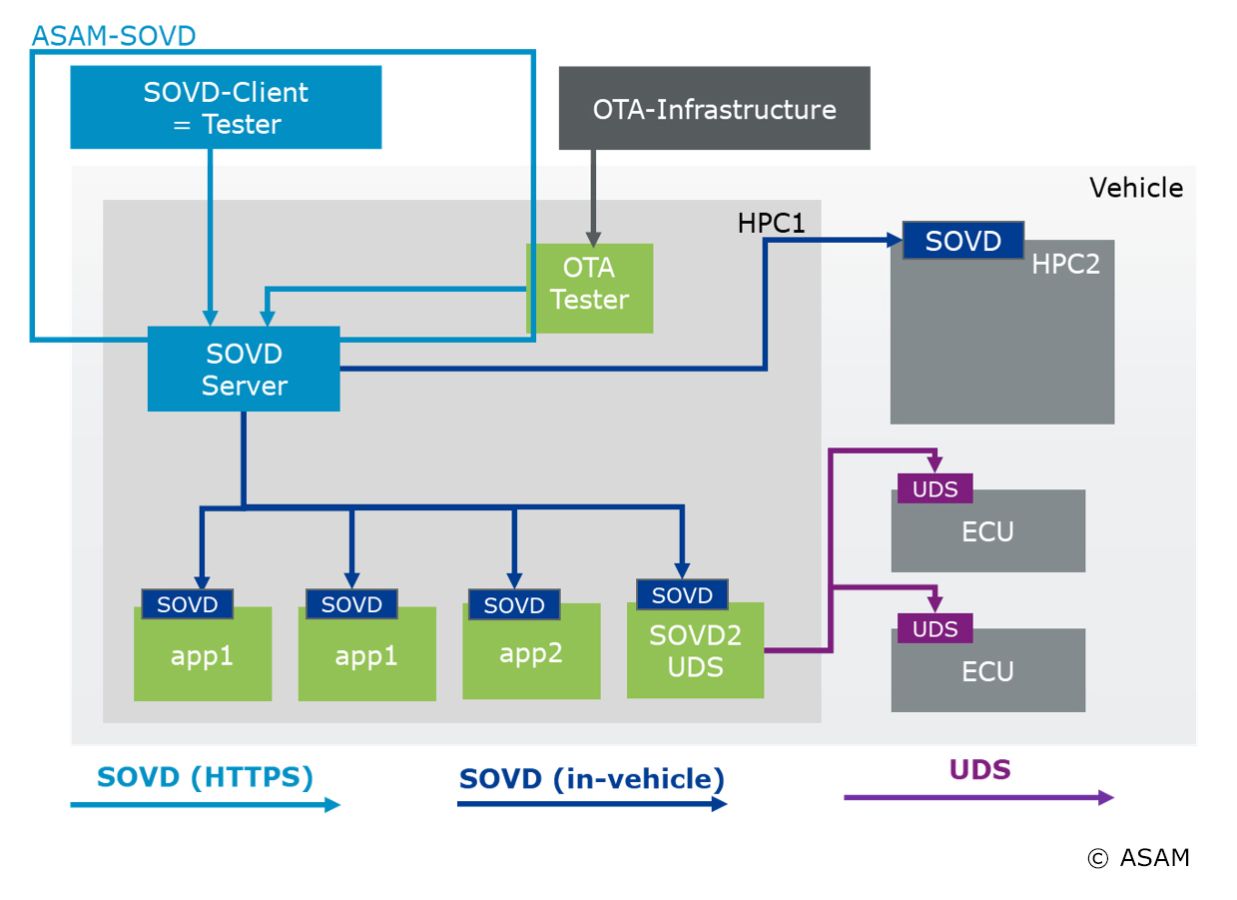
ASAM SOVD
The goal of ASAM SOVD is to specify a uniform API for new systems and traditional sensor/actuator diagnostics.
An important premise for the development of ASAM SOVD was the use of suitable technologies, not the invention of a new technology. The SOVD API is based on an http/REST-based approach.
The ASAM SOVD API supports content search to avoid the need for external data specifications. Nevertheless, there are mechanisms for offline documentation and specification to best support development, production, and after-sales processes.
ASAM SOVD focuses on defining the interface (API). The implementation of SOVD in the vehicle is not part of the ASAM project. Parallel activities in AUTOSAR standardization have created the necessary conditions for an AUTOSAR-based SOVD implementation.
ISO SOVD - ISO17978-3
The ISO17978 series of standards also transfers SOVD standardization to ISO. This release also expands the API with additional functionalities such as trigger-based and cyclic data queries, the execution of diagnostic scripts, and preparation for the use of SOVD for legal applications.
The development of SOVD in ASAM and ISO is synchronized. The ISO17978-3 release is therefore also published in ASAM SOVD at the same time.
Good to Know
Benefit from a variety of documentation on SOVD.
Presentation: ASAM Technical Seminar on SOVD
Whitepaper: Diagnostics Beyond UDS
Whitepaper: SOVD Hands On – SOVD in Practice
Related Content