System Testing and Environment Simulation in Medical Technology
As medical devices become increasingly software-driven, connected, and automated, system testing is no longer a late-stage verification task. It is a strategic capability that supports safety, reliability, and regulatory readiness throughout the development lifecycle.
Modern MedTech systems must be validated under realistic operating conditions, long before every physical prototype is available. This requires scalable test environments that combine simulation, automation, and traceable execution across software, hardware, and integrated subsystems. With SIL, HIL, and model-based testing approaches, engineering teams can identify risks earlier, increase test coverage, reduce prototype dependency, and create consistent evidence for verification and validation. Vector provides a powerful framework for system testing and environment simulation in medical technology, helping manufacturers develop complex embedded and networked devices more efficiently while maintaining the high quality standards required in safety-critical healthcare applications.

Reduce Prototype Dependency and Reveal Risks Earlier with Virtual Testing
As software-driven functionality, connectivity, and automation become standard in medical technology, even conventional devices are turning into complex, safety-critical systems. At the same time, development cycles are under pressure to become faster and more efficient.
To balance innovation speed with patient safety, manufacturers need test strategies that shift verification and environment simulation early in the lifecycle. Virtual testing and automated simulation help uncover risks sooner, reduce dependence on costly prototypes, and build the traceable evidence required for regulatory approval.
Testing Early in Realistic, Simulated Environments
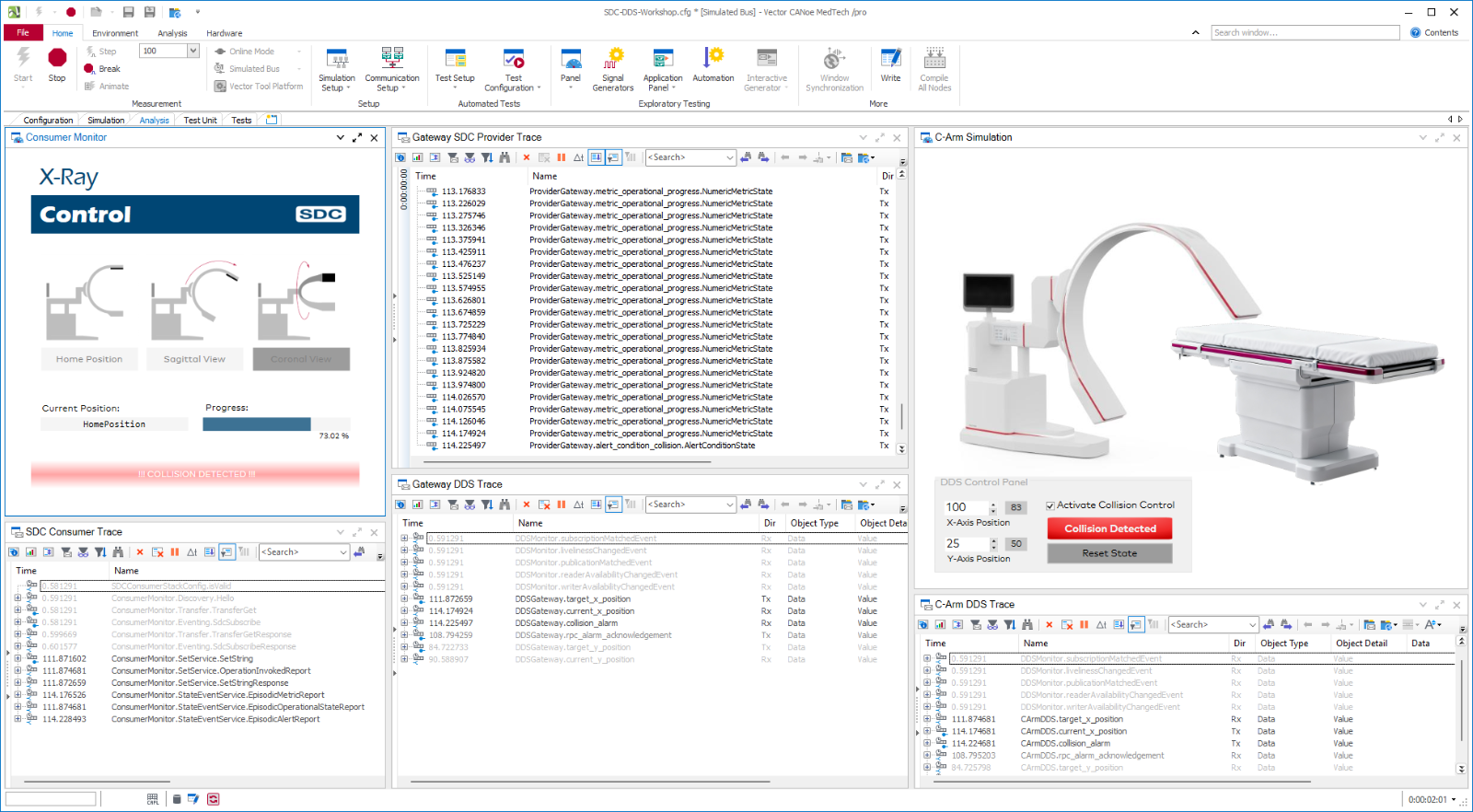
Complex medical systems require comprehensive testing and debugging to ensure safe and reliable operation. To save costs and effort, testing should take place early during development and in a simulated environment. This allows engineers to validate system behavior under realistic operating conditions without the need to build functional prototypes for every developer.
System Testing and Environment Simulation with CANoe MedTech
The test tool CANoe for MedTech by Vector provides a powerful platform for system testing and to simulate the operational environment of embedded systems and networked devices—from early development to full system integration. This enables engineers to analyze complex interactions, verify functionality, and validate system behavior efficiently across different development phases.
Scalable SIL and HIL Test Environments for Medical Devices
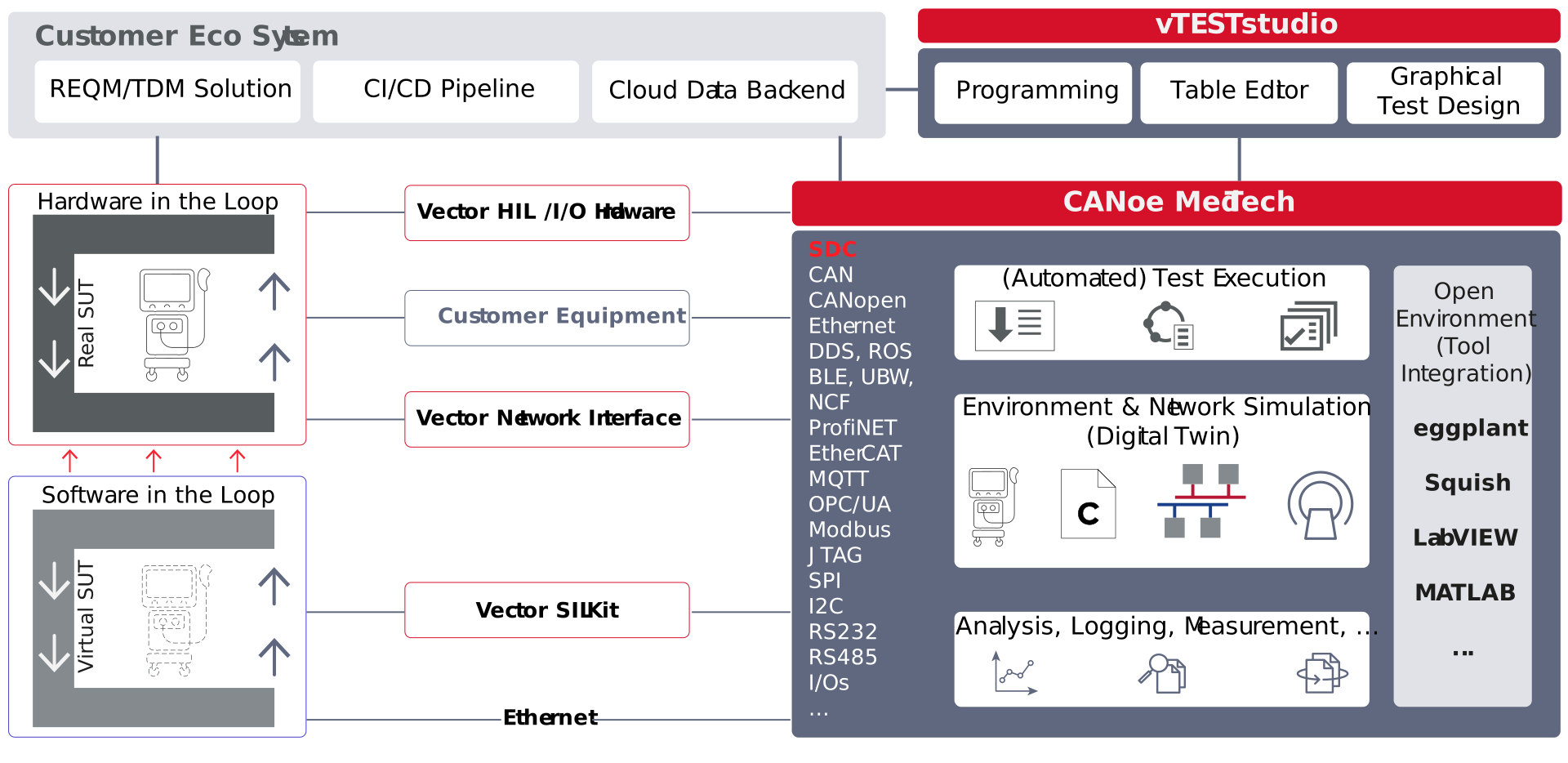
With both Software-in-the-Loop (SIL) and Hardware-in-the-Loop (HIL) capabilities, CANoe and the Vector HIL hardware (VT and VIO Systems) enable scalable, automated test environments for connected microcontrollers, microprocessors, and medical device subsystems. These environments support system-level verification, operating-environment simulation, and integration testing, accelerating development and increasing test coverage.
Structured, Reusable Test Design with vTESTstudio
The capabilities of CANoe are complemented by the tool vTESTstudio, which simplifies test design to create structured, reusable test cases for automated testing — easily integrated into existing quality assurance workflows. A high degree of test case reusability from the SIL to the HIL phase supports efficient test development and consistent execution. Central orchestration, automation, and comprehensive reporting ensure full traceability and repeatability throughout all test stages.
Related Pages
Safety-Critical Embedded Software
Executable-ready embedded stacks and drivers that simplify development and support regulatory compliance.

Software Quality & Compliance
Comprehensive tools for static and dynamic code analysis to ensure high software quality and compliance with medical standards.
Cloud, Connectivity & Interoperability
Seamless and secure cloud integration, device connectivity, and interoperability with communication protocol solutions such as SDC, DDS, and other medical middleware.

SDMD Services & Certification
Enabling the next generation of Software-Defined Medical Devices (SDMD) — powered by Software Factory and Consulting Services.