
The eMobilityAnalyzer is a function library that simplifies measurements in the development of electrified vehicles. As the core of the scalable eMobility Measurement System, it calculates meaningful derived parameters from raw signals such as current and voltage using complex mathematical algorithms. The results are generated online as calculated signals and can be used immediately for visualization, trigger conditions and further calculations.
Highlights
- Laboratory‑grade power analysis: Use power analyzer functionalities in an automotive‑grade measurement system.
- Online signal processing: Calculate high‑speed input signals directly during measurement.
- Immediate result availability: Use calculated parameters right away for recording, triggering and further processing.
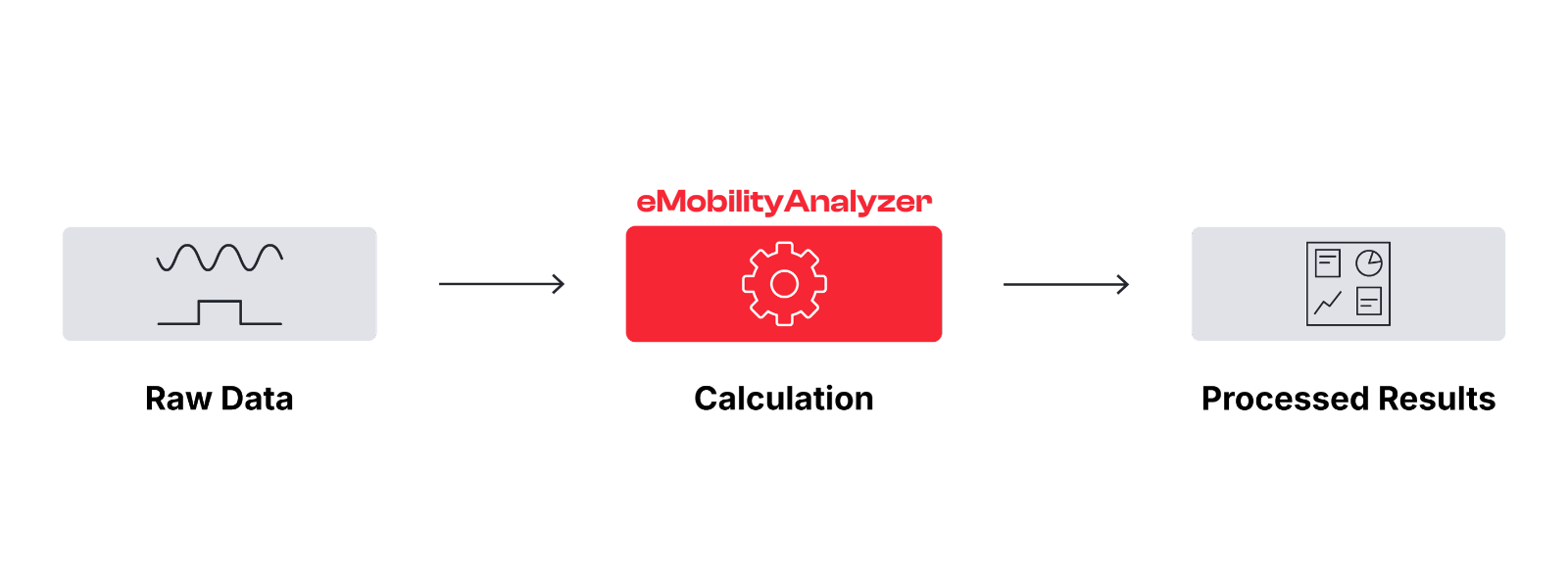
An easy to use graphical user interface simplifies the usage of the algorithms. The system generates results online as a calculated signal. These signals can be used right away, e.g. for visualization, in trigger conditions or further calculations. The online availability of the results, without a time-consuming post-processing interim step allows more
effective test methods.
Main Application Areas
Three Phase E Motors
The eMobilityAnalyzer supports the analysis of three‑phase electric machines including power, energy and phase relationships.
Inverters
For inverters, the eMobilityAnalyzer enables calculation of efficiency, power flow and losses.
HV Power Nets and Components
The eMobilityAnalyzer is used for compliance testing of high‑voltage power nets and components, for example according to LV124 and LV148.
AC and DC Chargers
For AC and DC chargers, the eMobilityAnalyzer calculates efficiencies, power balances and energy profiles during charging processes.
Pulsed Loads
For pulsed loads such as PTC heating elements, the eMobilityAnalyzer analyzes power consumption and signal‑based parameters.
DC DC Converters
The eMobilityAnalyzer supports the analysis of DC DC converters with respect to efficiency, power and losses.
Functions
Alpha Beta
Transforms three phase quantities into the stator-fixed reference system.
Axle Power
Similar to Shaft Power but for two external sensors. In addition, the average rotational speed and the total torque are determined.
ChargerEfficiency
Measure the efficiency of on-board chargers supplied directly by the power grid. Based on the voltages and currents of the output and the three input phases, it calculates the active input and output powers, and total energies. These provide the overall efficiency and power losses of a charge cycle.
DC Analysis
Determination of the active power and energy as well as the residual ripples on voltage and current in the DC area. Applications are in both the traction area (input of the inverter) as well as the with on-board power supply analysis used for testing the compliance of high-voltage components.
DC Efficiency
The main values during the design and optimization of components are the losses that occur in the components. The function directly calculates the efficiency from the input voltages and currents, as well as the output of the component under test. Overall efficiency and power losses are also calculated.
eMotorPhaseAnalysis
Determines the phase relationship between voltages and currents of a three-phase e-machine.
eMotorPowerAnalysis
Determines active power, apparent power, reactive power, electric speed and total energy of a 3-phase e-motor in star/Y or delta configuration. Furthermore, the active power of the separate windings are calculated.
eMotor Y-Delta
Based on the voltages between terminals and the phase currents, this function conducts the Y-delta and delta-Y transformation. It is useful for checking a proper wiring before usage of the power analyzer function eMotor Power Analysis.
Frequency
Determines the fundamental frequency of an oscillation.
Harmonic Power
Harmonic Power is an extension to the HarmonicAnalysis function for calculation of the active power of the fundamental and higher harmonics.
Inverter Efficiency
Calculates the efficiency of a three-phase inverter. Also calculates the consumed and produced effective power, and the dissipated power.
Phase Analysis
Phase angle and time shift between two periodic signals are analyzed based on their fundamental oscillations. The root-mean-square-values of the fundamentals are also calculated.
PWM Power Analysis
Analyzes power consumption of loads driven by pulse width modulated inputs (PWM). Besides calculation of active, apparent, and reactive powers, it determines typical properties of a PWM signal, such as base frequency, duty cycle, etc.
Ripple
Returns the parameters regarding the fluctuations of a given input signal as well as its average and root-mean-square value. It is the ideal function to analyze residual ripples, if power measurement is not needed.
Shaft Power
Calculates mechanical power and work based on rotational speed and torque of an external sensor. The output is averaged over a specified time window.
Single Frequency Analysis
This function conducts a Fourier analysis for a single prescribed frequency. It corresponds to the calculation of a single bin in a discrete Fourier transform (DFT). The function offers windowing and calculates root-mean-square-values and levels.
eMobilityAnalyzer is included in
Related Products