In bypassing, parts of the ECU software are executed on a hardware platform outside of the ECU with deterministic response times. This lets you modify functions quickly without having to run through the entire ECU code generation and flash process. Bypassing makes sense when new functions cannot be executed with the existing ECU hardware, e.g. if there is insufficient memory or CPU performance.
Highlights
- Easy creation: Program the functions (DLLs) using MATLAB/Simulink or C code
Parallel functions: Multiple calculations can be run simultaneously and enabled or disabled
- Graphical representation: Visualization of the bypass and ECU models in CANape with access to measurement data and parameters
- Software simulation and validation: Test ECUs with real bus systems and high-resolution time triggering (full passing)
Application Areas
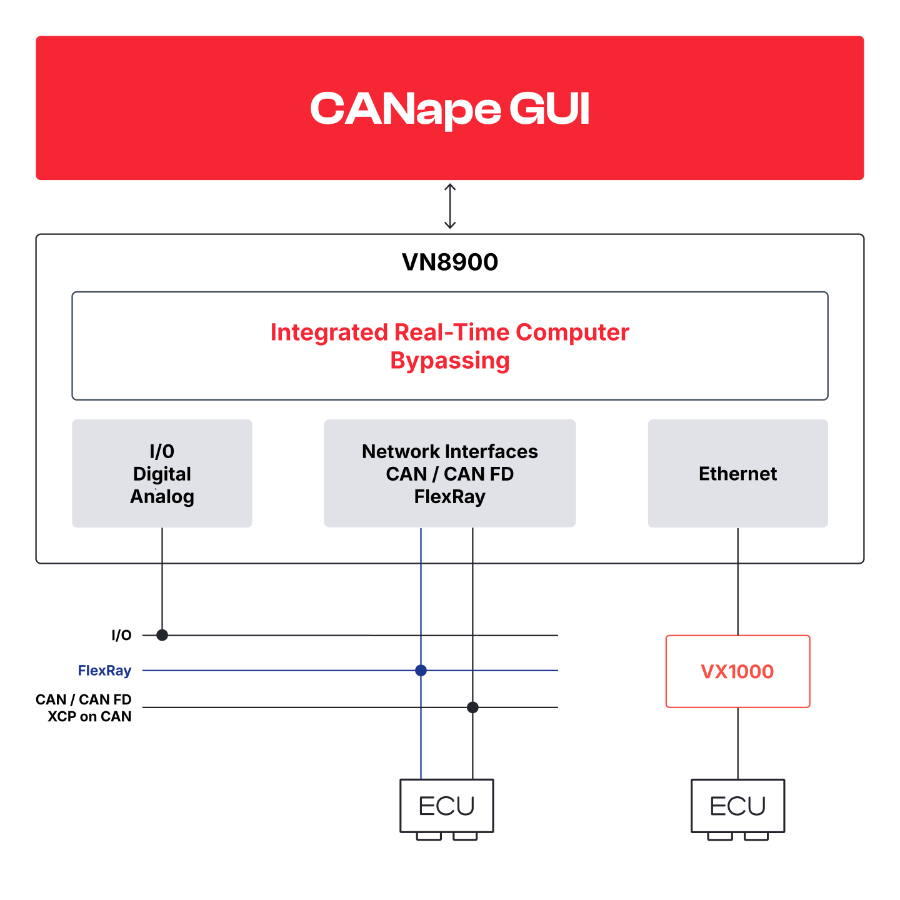
A complete bypassing solution is available to you by interlinking CANape, VN8900 and the VX1000 measurement and calibration hardware. The VN8900 network interface serves as the computational platform here, and the VX1000 System assures a connection to the ECU. In CANape, the overall solution is configured, and the signals and parameters are visualized.
Functions
In the Simulink model or C code, you define your function and place CANape I/O function blocks at the model’s inputs and outputs. After code generation, compiling and linking, a DLL is available in CANape for integration.
In CANape, the model’s inputs and outputs are linked to the real signals from the ECU. The bypassing algorithm is automatically transferred from CANape to the VN8900 by a configuration change. At model runtime on the VN8900, you acquire the necessary input data from the ECU via the VX1000 hardware, XCP on Ethernet, XCP on CAN, CAN, FlexRay or I/O. Using CANape, you can then measure and calibrate the bypass algorithm on the VN8900 and the code in the ECU.
Product Descriptions
Related Products