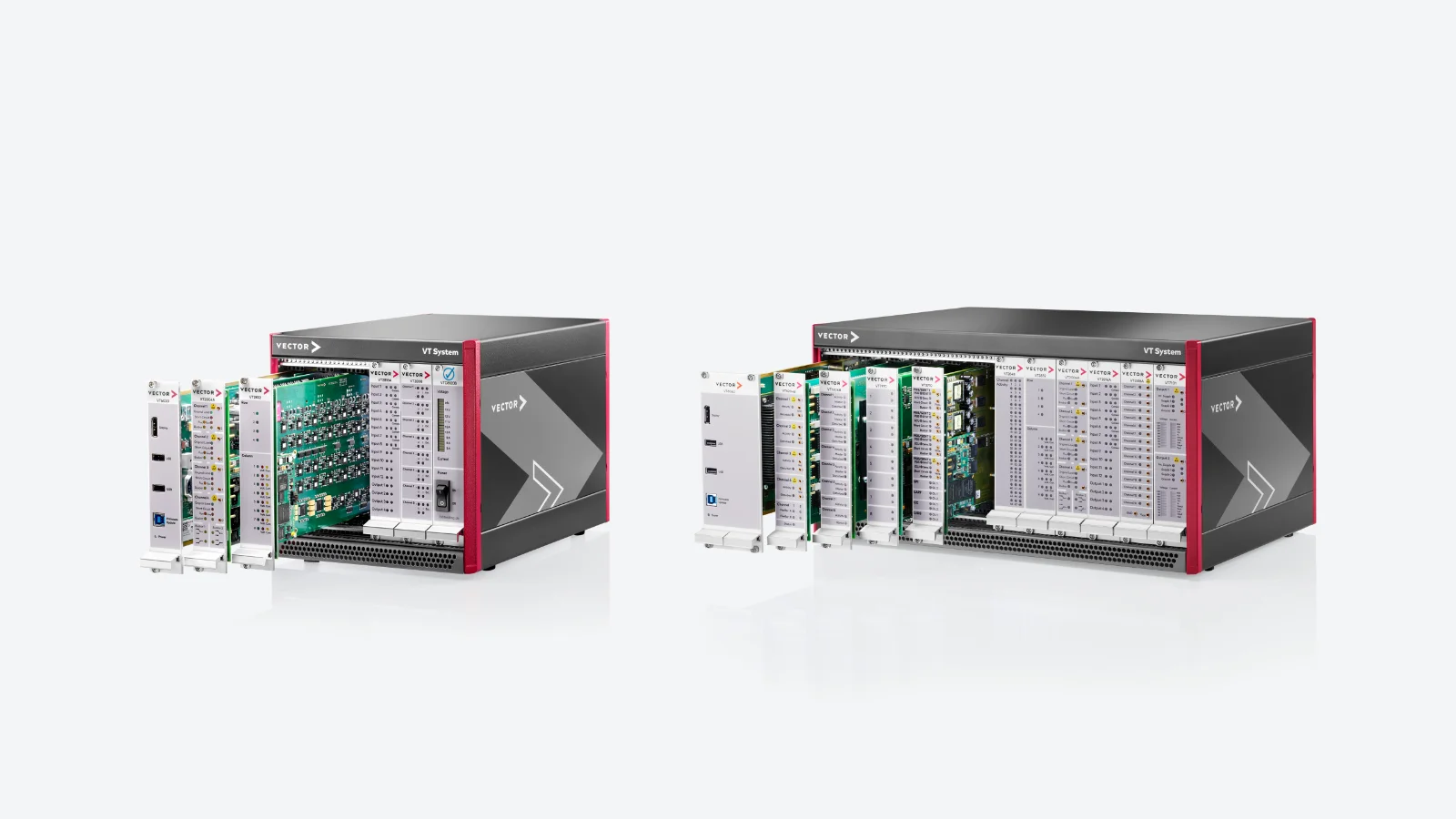
To test ECUs thoroughly, it is not only necessary to connect the communication networks to the test system, it is also necessary to connect the I/O interfaces.
This task is handled by the Vector VT System. It simplifies the setup of test benches and HIL test systems immensely, because it integrates all circuit components needed to connect an I/O channel in one module.
Examples of I/O channels are an ECU's output for controlling a headlamp or input for connecting a brightness sensor.
Advantages
All relevant test components are integrated into a single device:
- Measurement hardware with signal conditioning
- Relays e.g. for switching short-circuits
- Electronic load for actuator simulation
- Resistance decade for simulation of a sensor
- Minimal wiring effort for test setups
- Voltage range adapted to automotive applications
- Seamless integration into CANoe
Application Areas
With the VT system test systems for the function test of ECUs and vehicle networks can be assembled. CANoe is the associated test automation software.
The modular design of the VT System allows to build test solutions ranging from simple test setups to complex test systems:
- Dedicated test systems for individual ECUs
- Universal function testers for ECUs and subsystems
- Flexible test hardware for the developer's work station
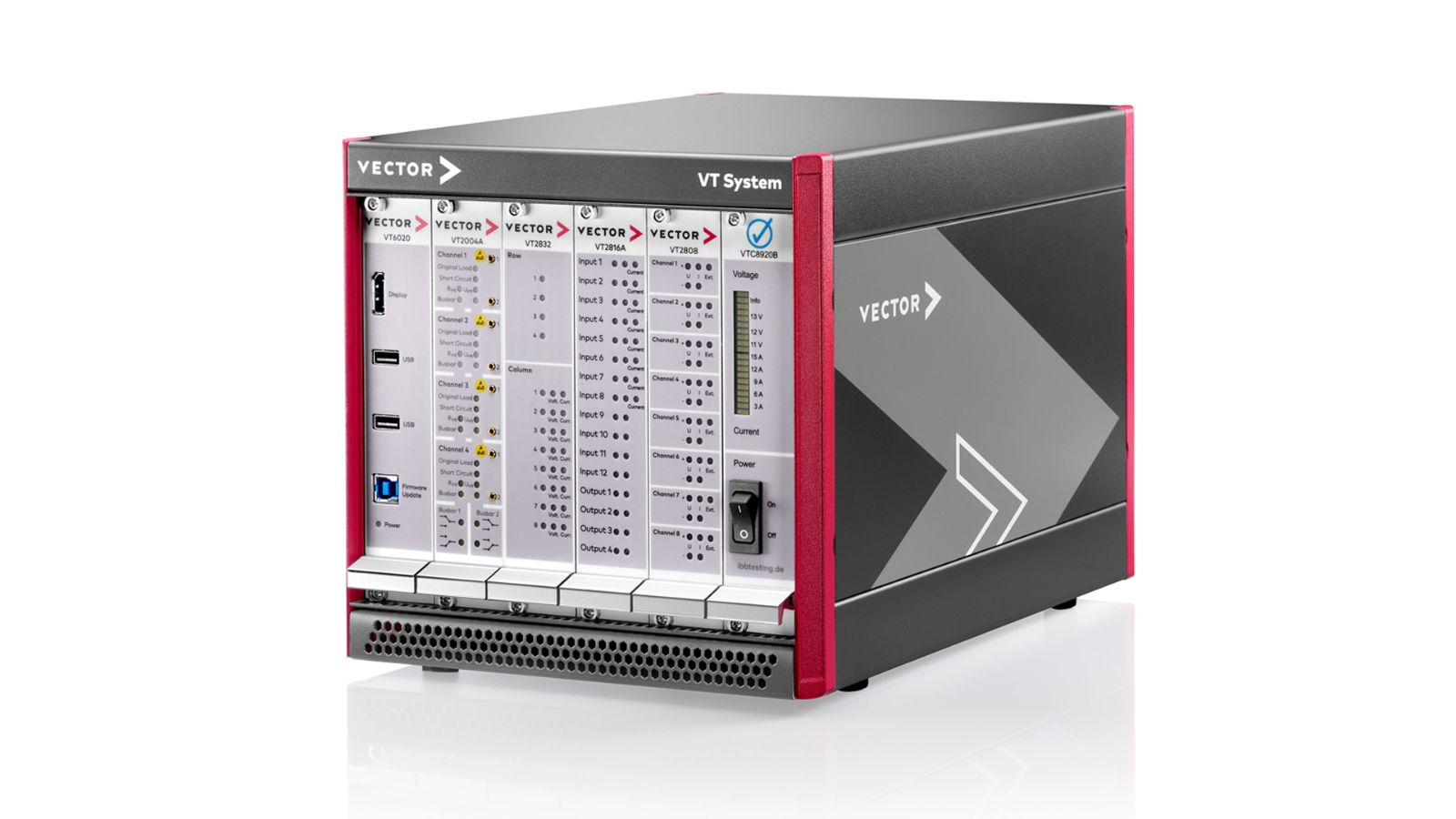
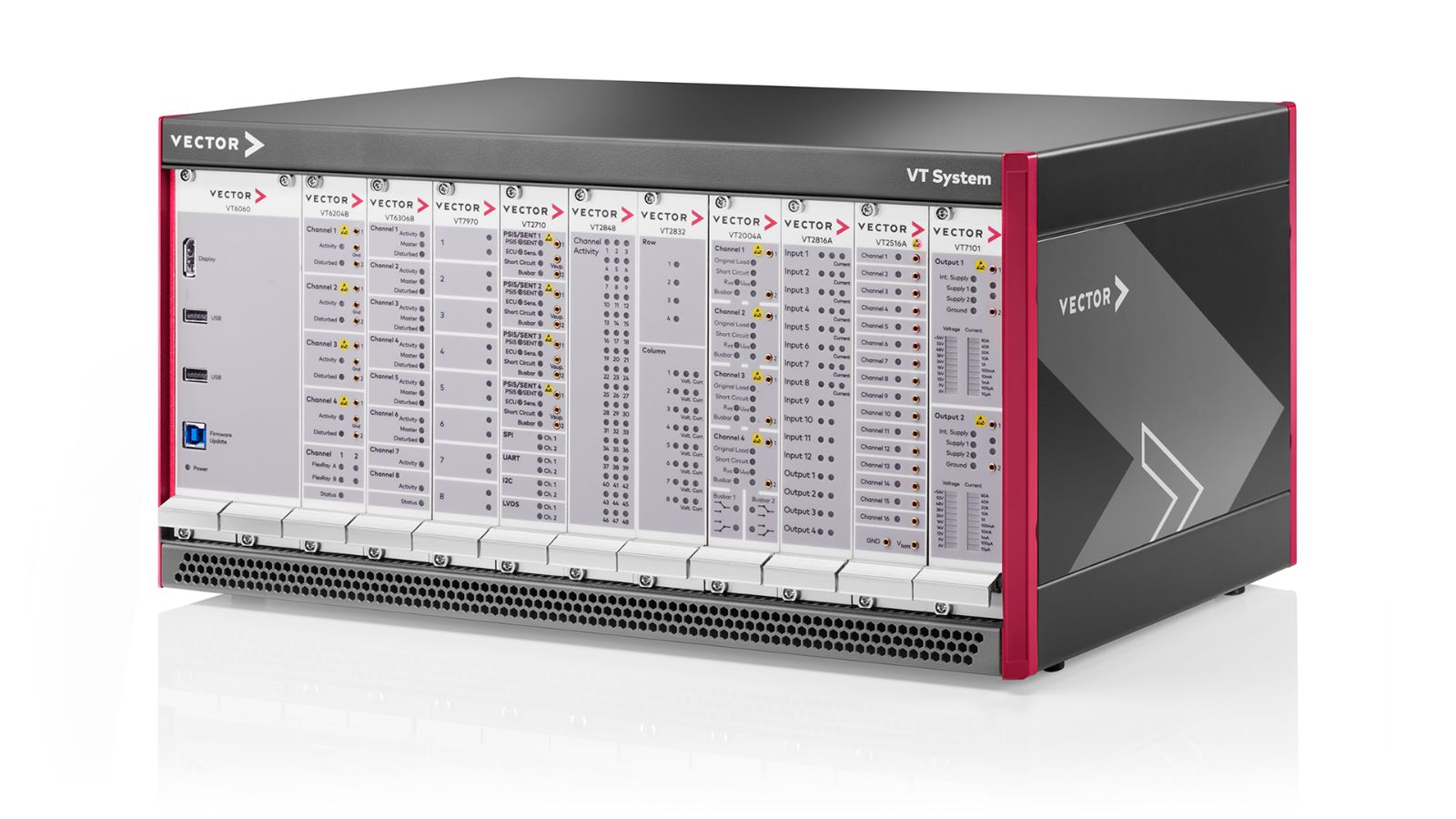
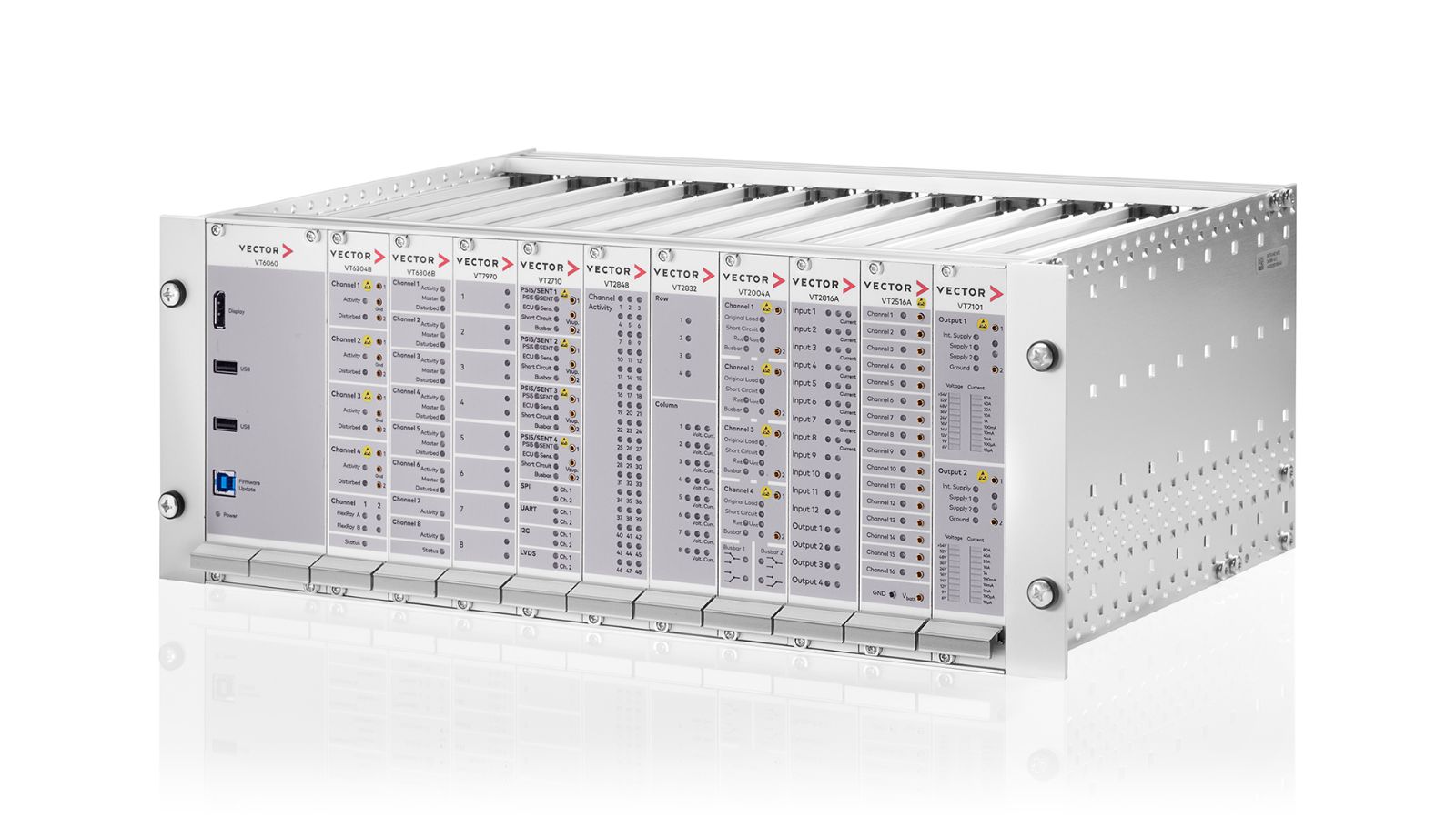
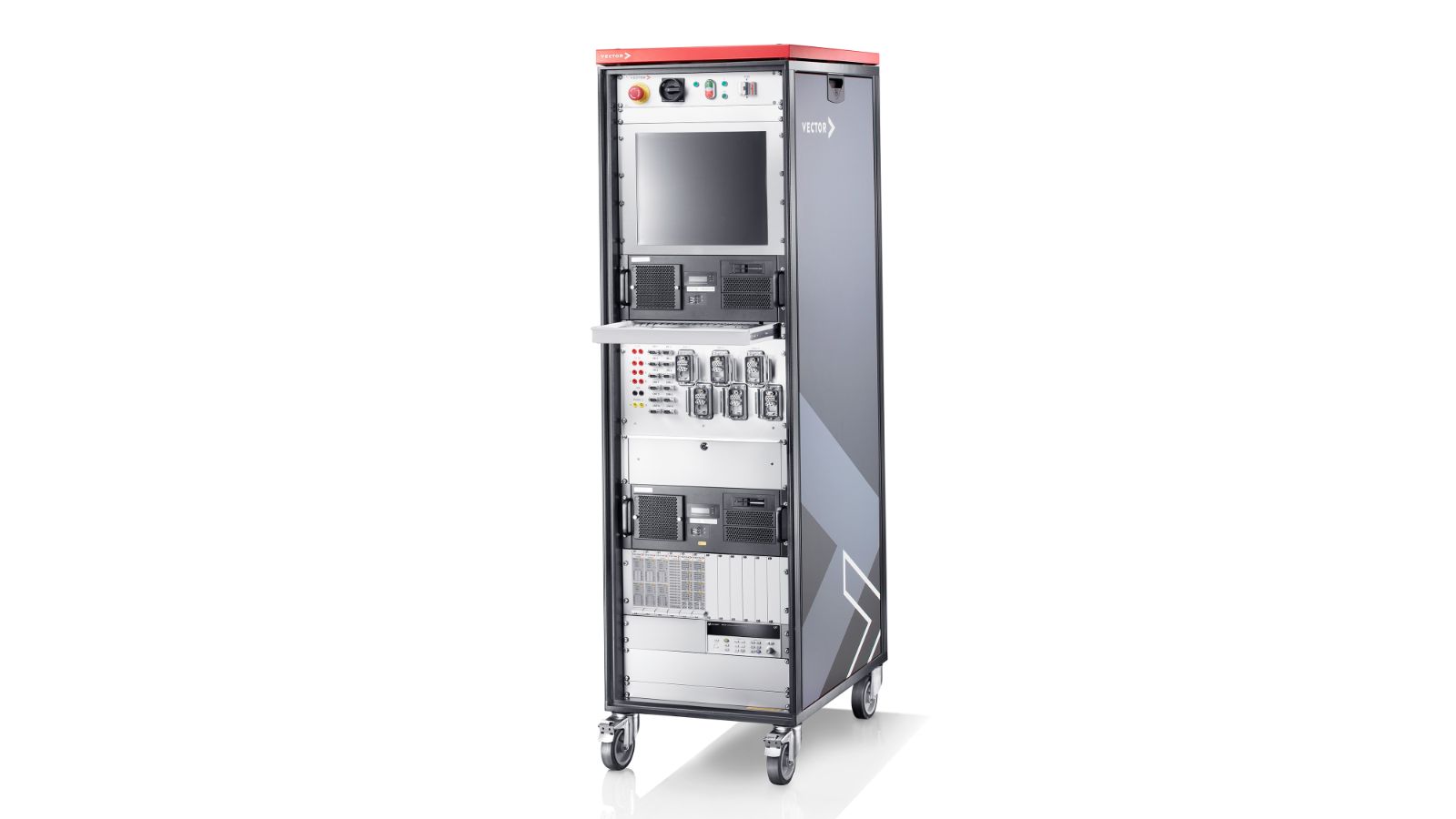
Housing: VT9006, VT9012, VT9112
The VT System is highly scalable. It can be used to set up test systems that range widely in complexity and functionality: from small auxiliary test tools at developer workstations to comprehensive functional testers and HIL test stations in the test laboratory.
Since the modules are universal in design, the test systems can be used for different test objects and test tasks without much effort.
Backplane
The backplane takes up the lower quarter of the housing height. In the space above, the plugin modules of the VT System are directly accessible from the back.
The backplane provides the Ethernet connection for the CANoe PC and supplies the VT System modules with 12V operating voltage. Each installed VT System module is also connected to the EtherCAT® bus through the backplane. With the second Ethernet connector, several VT System racks can be connected to bigger test systems. Vector also provides completely assembled test racks on a project basis.
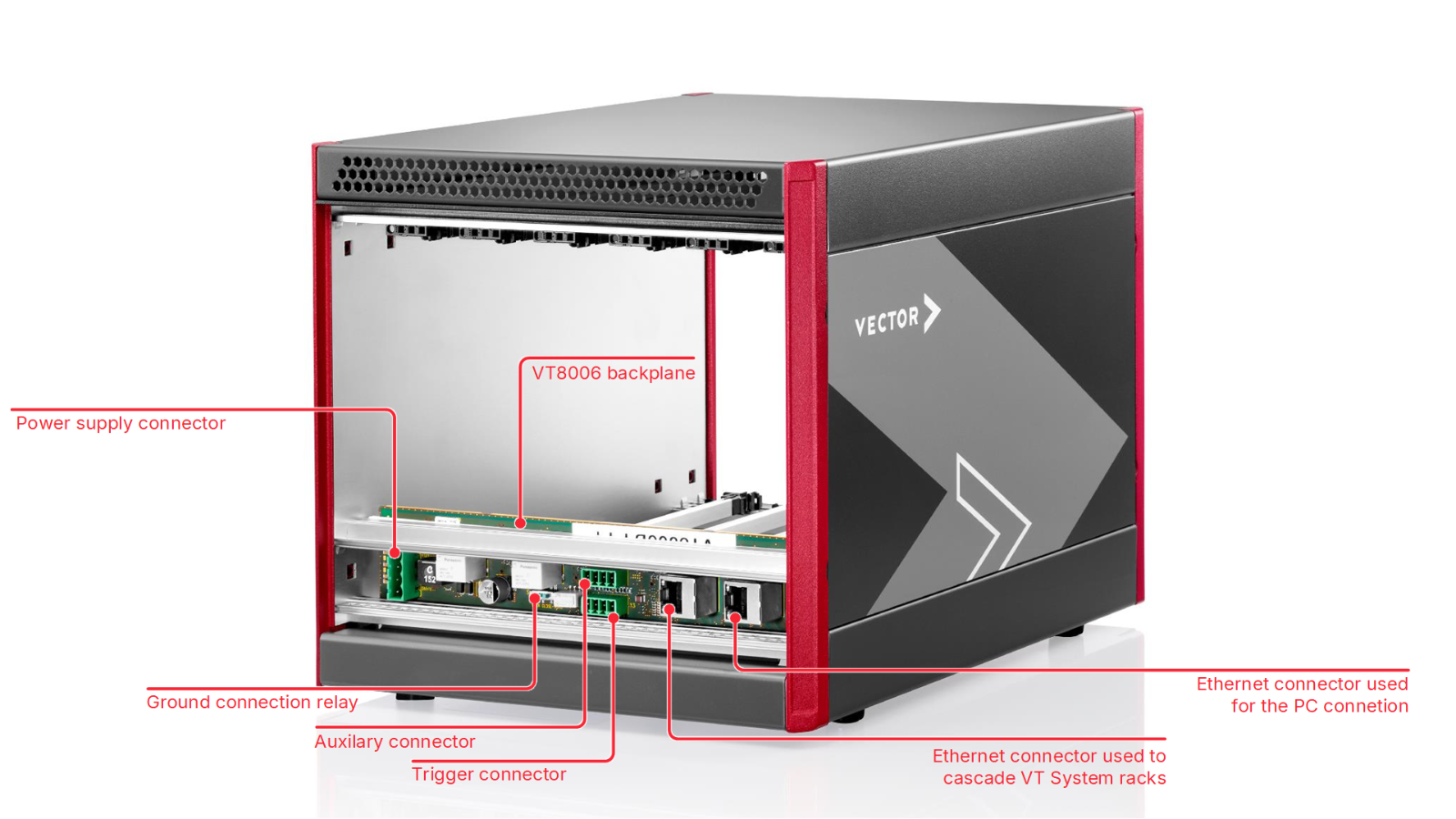
Backplane VT8006B
Using the VT8006B backplane, up to six VT System modules can be installed in a 9.5-inch desktop housing VT9006.
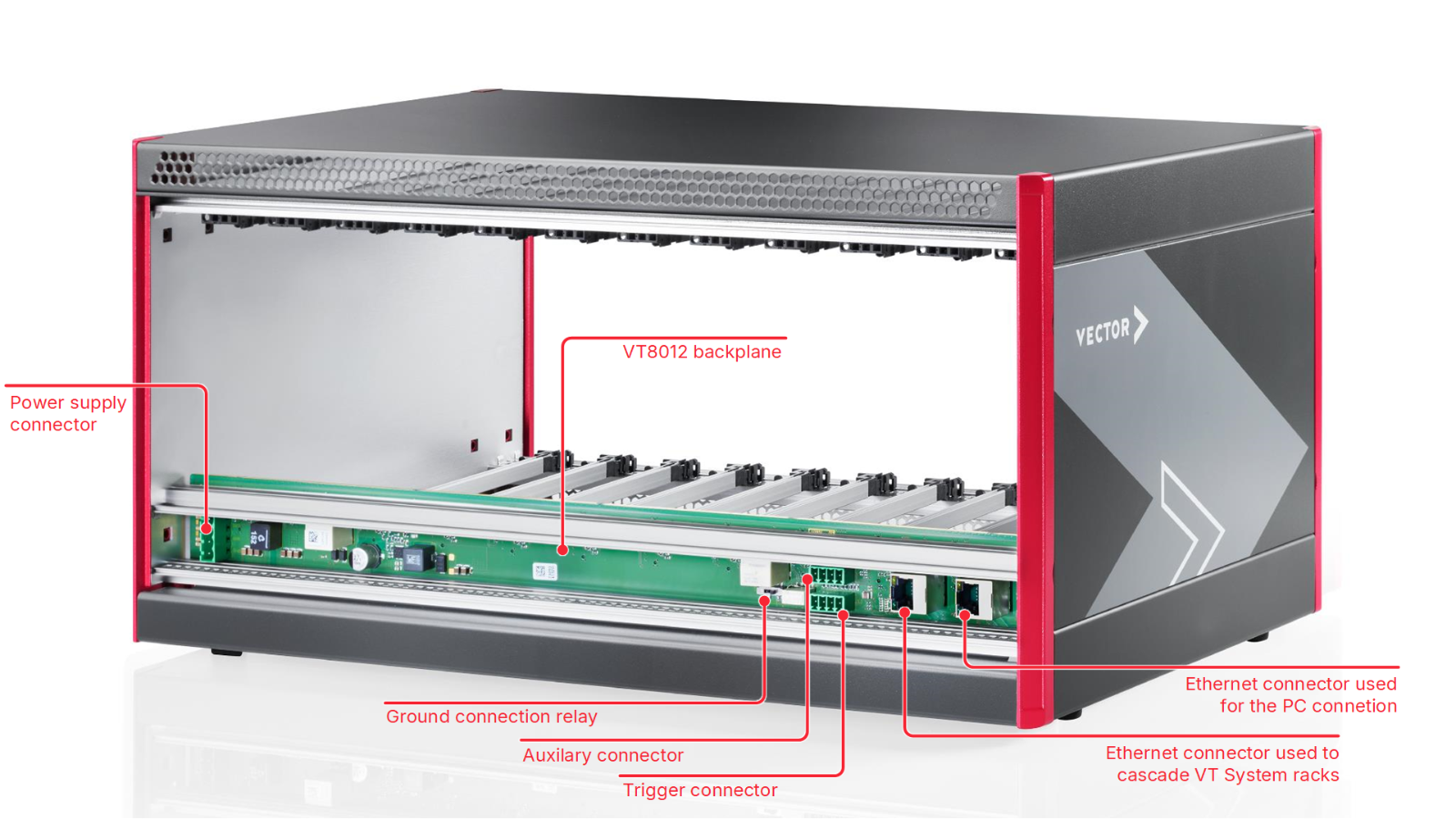
Backplane VT8012B
The VT8012B backplane is the bigger variant of the VT8006B. Mounted in a 19-inch desktop case VT9012 or in a 19-inch rack frame VT9112 (4 U), up to 12 VT modules can be installed.
Technical Data
| VT8006B, VT8012B | |
| No. of slots | 6 (VT8006B), 12 (VT8012B), |
| Supply voltage | 12 V ±10 % |
| Input current | Max. 16 A, depending on type and number of plugged-in VT System modules |
| Power consumption (backplane only) | Approx. 3.8 W |
| Temperature range | 0 … 55 °C |
| Dimensions (L x W x H) | 210 x 46 x 35 mm (VT8006B), 427 x 46 x 35 mm (VT8012B) |
Overview
The VT System is a high-performance modular test system for comprehensive ECU testing. It consists of different hardware modules and together with CANoe it offers a powerful and flexible solution for testing ECU functions and important errors cases.
| Infrastructure Modules |
| ● VT7900A | VT7900A FPGA: Extension Module |
| Real-time Modules |
| ● VT6020: Real-time Module |
| ● VT6060: Real-time Module |
| Fault Injection + Switching Modules |
| ● VT2820: General-Purpose Relay Module |
| ● VT2828: Signal Switching Matrix Module |
| ● VT2832: Switch Matrix Module |
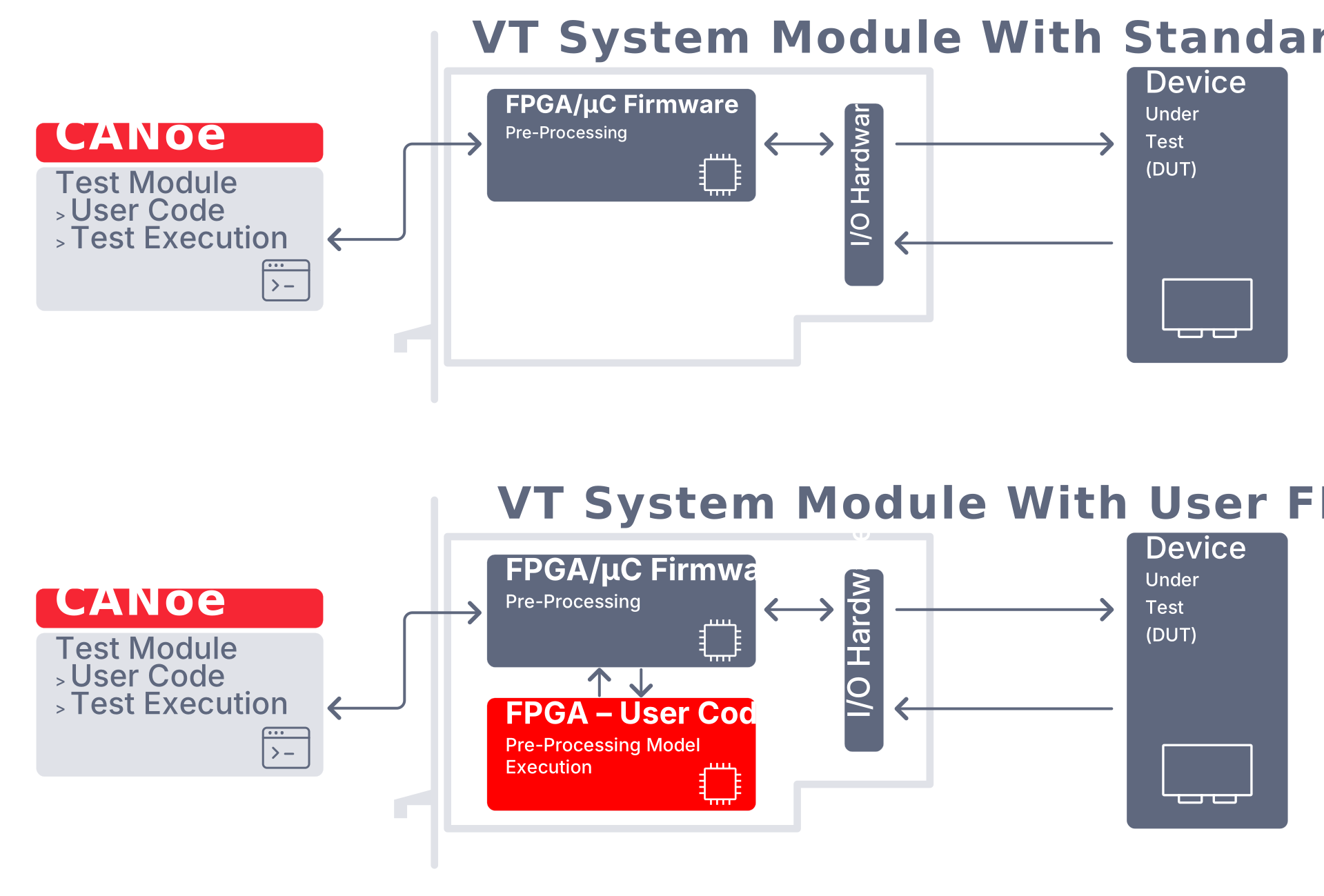
User-Programmable FPGA
Some VT System modules are available as FPGA variant with a processor board which includes a second, user programmable FPGA. This FPGA has access to the I/O hardware on the VT System modules and communicates with CANoe and therefore allows the implementation of customer specific functionality.
Calibration
Standard: ISO/IEC 17025:2017
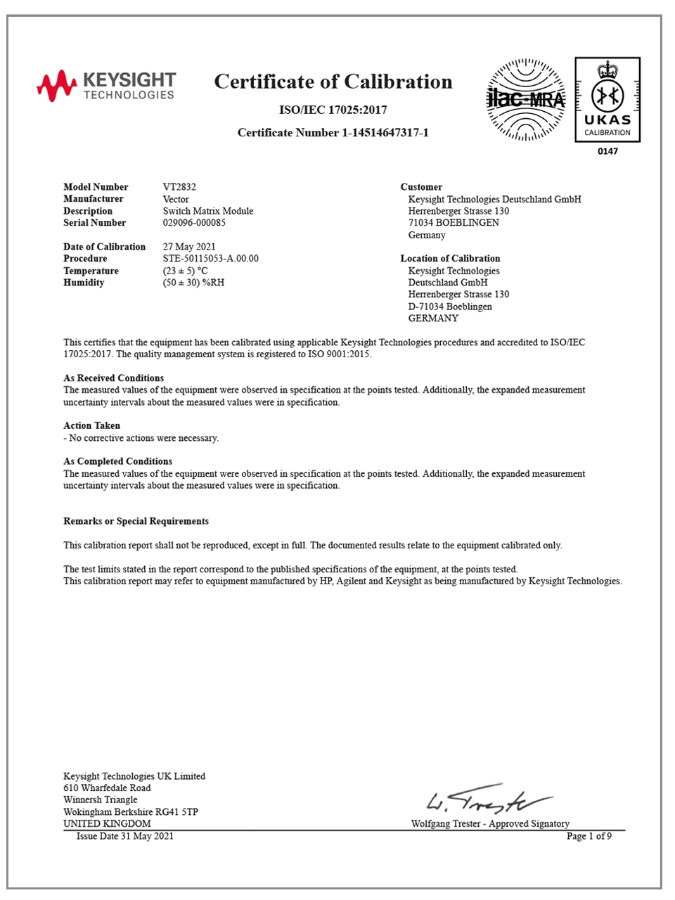
An accredited calibration service is offered for individual VT System modules. This service can be used as a pre-calibration or re-calibration (recommended every 12 months). Furthermore, the service is also available for modules that are already in the field and not only for new modules.
The service, where available, is offered in cooperation with Keysight Technologies Inc. and complies with the requirements of ISO/IEC 17025:2017. This makes it possible to perform a calibration in different, globally distributed laboratories (Germany, Japan).
This calibration service also includes an adjustment if any module is out of specification. A detailed report with all explanations, results and measurements is included with the calibration.
Full Integration in CANoe
CANoe automatically detects the VT System, and requires only a few mouse clicks to configure the system. Essentially, it is only necessary to select the required measurement signals and provide the channels with speaking names.
All measurement and output values are then available in CANoe in the same way as other signals. For example, the signals may be displayed in analysis windows, and they can be recorded and accessed in test modules. It is easy to manually control tests in this way, but they can also be automated in CANoe using test modules.
The VT System adds the following functions to the test automation features of the CANoe and vTESTstudio:
- Automatic recognition of the modules of a connected VT System
- Easy configuration via specific dialogs in CANoe
- Management of the entire VT System in CAPL and/or XML test modules, access to all measurement and stimulation signals
- Display of measurement signals in the analysis windows (Graphics Window, Data Window), recording with the Logging block of CANoe